
You are here:
- Home
- Running Plans
- Marathon Training Plans
- Marathon Training Plans by Goal Time
- 3:15 Marathon Training Plan
3:15 Marathon Training Plan
Written by Andrew Taylor. USATF Level 1 Coach. Coaching runners since 2010.
3:15 for a marathon is 7:26 per mile. The pace is not the hard part. Holding it at mile 22 is.
That is what this 16-week plan trains. Your goal pace is written into the workouts instead of left to race day, and you rehearse it on tired legs often enough that 26.2 feels like a repeat rather than a first attempt.
- 16 weeks
- 6 runs a week
- peaks at 56 mi/week
- longest run 20 miles
- 96 coached runs
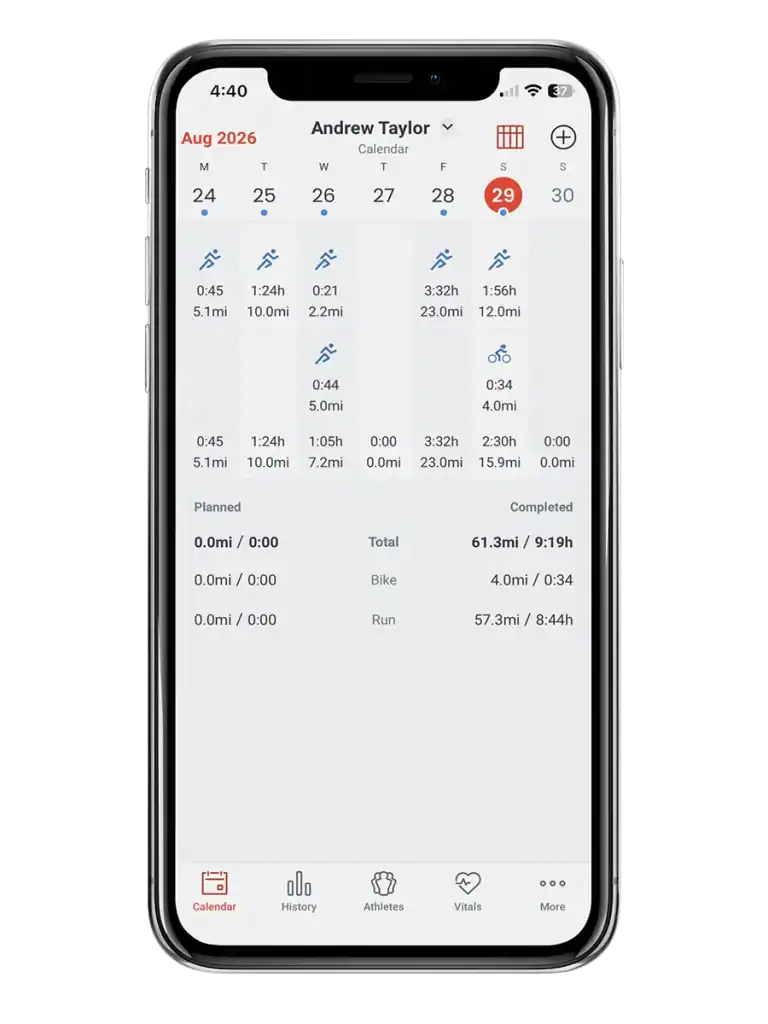
Your plan is delivered through Final Surge. The account is free. Sign in or create one at checkout, pay once, and the plan is yours. There is no subscription.

Before You Start
Week 1 opens at 36 miles with an 11-mile long run so you can step straight into goal-specific work. You are in the right place if you are running 30 to 34 miles a week across 5 to 6 days, can comfortably cover 11 miles, and carry recent race fitness around a 1:42 half marathon or 3:30 marathon. Closer to 24 miles a week or over 1:50 in the half? Match your current fitness to a slightly slower plan in our 16-week series first so you absorb the training and arrive at 3:15 ready to execute.
Is This You?
Not sure 3:15is the right target? Our running calculator will take a recent race result and show you what it projects.
Your Paces, Week 1 to Week 16
The plan runs on 5 pace bands. They are printed inside every workout, so you never have to look them up.
| Session | Pace per Mile |
|---|---|
| Recovery | 8:56 to 9:41 |
| Easy | 8:03 to 8:37 |
| Marathon pace | 7:21 to 7:31 |
| Threshold | 6:52 to 7:08 |
| Interval | 6:18 to 6:34 |
Your goal pace is 7:26 per mile. The marathon-pace band runs 5 seconds either side of it, and RPE is what decides on a hot day or a hilly route.
Why This Plan Stops At A Long Run Of 20 Miles
This plan caps the long run at 20 miles or 3 hours 15 minutes on your feet, whichever comes first. At a 3:15 goal, 20 miles at the slow end of your easy band takes 2 hours 52 minutes, so the distance caps the run rather than the clock. Rather than pushing past 20 miles into diminishing returns, we spend that extra capacity running 7:26/mile on tired legs inside the run.
Readiness comes from cumulative weekly volume, not one heroic Saturday. That is why your peak Week 13 long run is 20 miles with 2 goal-pace blocks inside it, taking roughly 2 hours 40 minutes rather than a shapeless 22- or 24-mile slog. The miles that make you a 3:15 marathoner are the 56 total miles you run across that week, not an extra 2 easy miles tacked onto Saturday.

What Makes A Sunrise Running Plan Different
A Real Week From The Plan
Here is how a peak marathon-specific week looks once goal pace becomes the center of your training.
| Day | Session | Distance | What It Asks For |
|---|---|---|---|
| Monday | Easy Run | 6 miles | Nothing. Run it at the pace you would run it on a day off. |
| Tuesday | 2 x 2.5 Mile Threshold Repeats, Strength and Mobility for Runners | 8 miles + 24 minutes | Two long threshold reps, then core, balance and upper body at its fullest. |
| Wednesday | Recovery Run | 4.5 miles | Deliberately slower than your standard easy pace. |
| Thursday | Medium-Long Run With Marathon Pace, Strength and Mobility for Runners | 10.5 miles + 28 minutes | 3 easy, 6 at goal pace, 1.5 easy. Then the heaviest lower body session of the week. |
| Friday | Easy Run With Strides | 6 miles | Easy miles, then about 20 seconds of relaxed speed to finish. |
| Saturday | Long Run With Marathon Pace Segments | 17 miles | 10 easy, 2 at goal pace, 1 easy, 2 at goal pace, 2 easy. Allow about 2 hours 20 minutes. |
| Sunday | Rest Day, Mobility and Recovery | 30 minutes | The one session in your week with nothing hard in it. |
| Week total | 52 miles | The opening week of the marathon-specific block. |
Every workout syncs directly to your watch with pace bands and effort targets built in.
Every Week Opens With A Note Like This One
Before your first stride on Monday, you know the exact purpose of the week ahead and what to focus on.
Week 9 of 16 | Specific Phase | 52 Miles | 17-Mile Long Run
We officially enter the marathon-specific phase this week, putting goal pace front and center.
- Monday: Easy run
- Tuesday: 2 × 2.5 miles at threshold (0.5-mile jog recovery)
- Wednesday: Recovery run (deliberately slower than your standard easy pace)
- Thursday: 10.5 miles total featuring a 6-mile goal pace block
- Friday: Easy run with strides to finish
- Saturday: 17-mile long run featuring 2 goal pace blocks totaling 4 miles
- Sunday: Rest day
Goal pace execution: Running goal pace on accumulated fatigue is the entire purpose of this block. With Thursday’s effort stretching to 6 miles and Saturday’s long run introducing 2 goal pace blocks, your body is learning how to lock into rhythm twice a week.
This Week’s Focus:
- Settle, don’t chase: Let goal pace come to you. Avoid forcing the effort early.
- Rehearse your fueling: Treat Saturday’s long run like a dress rehearsal for race day nutrition and hydration.
- Keep easy days truly easy: Stick to the slower end of your easy pace band to absorb the harder sessions.
- Prioritize sleep: Treat recovery like a key session, because it is.
Looking ahead: Next week climbs to 56 miles with an 18-mile long run.
You receive 16 weekly coaching notes like this, plus a separate coaching note on every individual run.
The 16 Weeks, Phase By Phase
The plan moves through seven named phases so your fitness peaks on race morning rather than in Week 8.
| Weeks | Phase | Mileage | Long Run | What It Does |
|---|---|---|---|---|
| 1 to 4 | Foundation | 36, 41, 45, 33 | 11, 12, 14, 10 | Establishes easy-day discipline before goal pace appears. Interval work on Tuesday. Week 4 steps back. |
| 5 to 8 | Build | 45, 49, 52, 37 | 14, 15, 16, 11 | Threshold takes over Tuesday in Week 6 and marathon pace enters the long run. Week 8 steps back. |
| 9 to 10 | Marathon-Specific Build | 52, 56 | 17, 18 | Goal pace twice a week on accumulated fatigue, inside both the Thursday run and the long run. |
| 11 | Tune-Up Race | 36 | Half marathon | A half marathon at 1:31:30 turns your goal from an aspiration into a number, with a written rule for what the result means. |
| 12 to 13 | Peak | 56, 56 | 18, 20 | The 2 biggest weeks. Week 13 holds the 20-mile long run with goal pace inside it, about 2 hours 40 minutes. |
| 14 to 15 | Taper | 43, 32 | 12, 8 | Volume comes down and the quality stays. The supporting strength work lightens with it. |
| 16 | Race Week | 43 | Marathon | 17 miles before the race. Tuesday holds the last goal pace you will run, 2 x 1 mile, short enough to sharpen. |
What You Get Inside The Training Plan
Every item below exists to do one thing, put 7:26 per mile in your legs and keep you healthy enough to use it on race day.
- 16 Weeks of Structured Training: 6 running days per week, calibrated specifically to a 3:15 finish (7:26/mile).
- 5.5 to 9.25 Hours a Week: including both strength sessions and Sunday mobility, so you know what you are committing to before you start.
- Watch-Ready Workouts: Every run includes exact pace bands and RPE targets that sync straight to your watch.
- Daily & Weekly Coaching Notes: 16 weekly overview notes plus individual execution cues on every single run.
- Built-In Week 11 Fitness Check: A tune-up half marathon (1:31:30 target) with clear rules on whether to hold or adjust your goal pace.
- Runner-Specific Strength & Mobility: Two weekly bodyweight strength sessions and a Sunday mobility routine designed to build durability without extra impact.
- 9 Supplemental Coaching Guides: Complete manuals covering activation warmups, technique drills, race-day pacing, and marathon fueling.
- Lifetime Access via Final Surge: Pay once and keep the plan forever, with full calendar flexibility and zero subscription fees.
How It Works
Final Surge is free to use. You pay once for the plan, never a recurring subscription.
Frequently Asked Questions
30 to 34 miles a week across 5 to 6 days. Week 1 opens at 36 miles with an 11-mile long run, so the plan starts where you already are rather than building you up to it.
7:26 per mile, or 4:37 per kilometer. The plan’s marathon pace band is 7:21 to 7:31 per mile, and that band is printed in every workout that uses it.
The plan caps the long run at 20 miles and at 3 hours 15 minutes on your feet, whichever comes first. At a 3:15 goal the distance stops it first. Readiness comes from cumulative weekly volume, not one heroic Saturday.
Add 5 seconds per mile to your marathon goal pace for every full minute you finish off the 1:31:30 target, and use that adjusted band starting Week 12. Adjustments only go one way, a faster half does not mean speeding up your goal, and you do not swap plans.
Because 3:15 is the Boston qualifying standard for men 45 to 49 and 3:10 is not a standard for anyone. The goal times in this line follow the qualifying brackets, so the plan you buy is aimed at a published number rather than a round one.
The plan writes out a Goal Pace Assessment Run for that Sunday instead, and it takes about 1 hour 30 minutes. If your race falls on Saturday, Friday’s rest day moves to Thursday.
No. Every movement is strictly bodyweight with zero plyometrics or jumping. Adding landing impact on top of hard running days only drives fatigue without extra benefit.
Yes. A 16-week pace-driven build is exactly the kind of thing worth having a second set of eyes on, especially if you are new to this volume. Learn about Sunrise Running Company run coaching.
Chasing a different time?
3:05 Marathon Training Plan
3:20 Marathon Training Plan
3:25 Marathon Training Plan
See all 17 goal-based plans
Nothing here fits? We can build a plan for your goal time.

Founder & Head Coach, Sunrise Running Company
Andrew is a USATF Level 1 certified running coach in Modesto, California, with 35+ years of running and 8 finishes at the 100-mile distance. He holds a BS in Exercise Science Education and an MA in Sports Management from Ohio State, and he writes every Sunrise Running plan himself.
16 Weeks to a 3:15 Marathon
Sixteen weeks, 96 coached runs, and a pace band on every single one of them. If you are running 30 to 34 miles a week and a 3:15 is the number you keep circling, this is the plan that gets you there.
You do not have to be certain about 3:15 to start. Week 11 puts you in a tune-up half marathon, and the plan tells you exactly how to adjust your goal pace if the number needs moving. No new plan, no second purchase.