
You are here:
- Home
- Running Plans
- Marathon Training Plans
- Marathon Training Plans by Goal Time
- 4:35 Marathon Training Plan
4:35 Marathon Training Plan
Written by Andrew Taylor. USATF Level 1 Coach. Coaching runners since 2010.
4:35 for a marathon is 10:29 per mile. The pace is not the hard part. Holding it at mile 22 is.
That is what this 16-week plan trains. Your goal pace is written into the workouts instead of left to race day, and you rehearse it on tired legs often enough that 26.2 feels like a repeat rather than a first attempt.
- 16 weeks
- 5 runs a week
- peaks at 40 mi/week
- long run capped at 3:15
- 81 coached runs
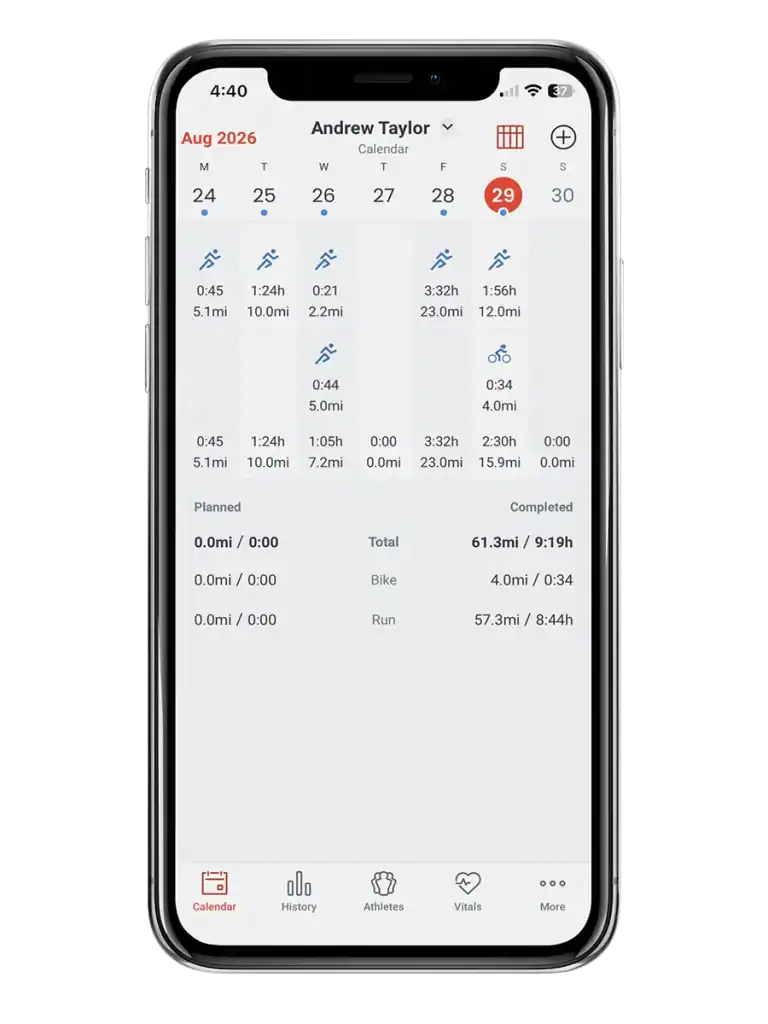
Your plan is delivered through Final Surge. The account is free. Sign in or create one at checkout, pay once, and the plan is yours. There is no subscription.

Before You Start
Week 1 opens at 26 miles with a 1 hour 45 minute long run so you can step straight into goal-specific work. You are in the right place if you are running 21 to 24 miles a week across 4 to 5 days, can comfortably run for 90 to 105 minutes, and carry recent race fitness around a 2:30 half marathon or 4:50 marathon. Closer to 17 miles a week or over 2:40 in the half? Match your current fitness to a slightly slower plan in our 16-week series first so you absorb the training and arrive at 4:35 ready to execute.
Is This You?
Not sure 4:35 is the right target? Our running calculator will take a recent race result and show you what it projects.
Your Paces, Week 1 to Week 16
The plan runs on 4 pace bands. They are printed inside every workout, so you never have to look them up.
| Session | Pace per Mile |
|---|---|
| Recovery | 12:23 to 13:08 |
| Easy | 11:13 to 11:58 |
| Steady | 10:29 to 10:49 |
| Marathon pace | 10:24 to 10:34 |
Your goal pace is 10:29 per mile. The marathon-pace band runs 5 seconds either side of it, and RPE is what decides on a hot day or a hilly route.
Why The Long Run Is In Minutes
This plan caps the long run at 3 hours 15 minutes on your feet, and prescribes it in minutes rather than miles. At a 4:35 goal, 20 miles at your easy pace takes 4 hours, against 3 hours for a 3:30 runner. Same distance, vastly different stress, and that extra time steals recovery from your goal-pace work. Rather than chasing a number on the watch, we spend that capacity running 10:29/mile on tired legs inside the run.
Readiness comes from cumulative weekly volume, not one heroic Saturday. That is why your peak Week 13 long run is 3 hours 10 minutes with 2 goal-pace blocks inside it, roughly 17 miles, rather than a shapeless 20-mile slog that costs you the following week. The miles that make you a 4:35 marathoner are the 40 total miles you run across that week, not an extra 2 easy miles tacked onto Saturday.

What Makes A Sunrise Running Plan Different
A Real Week From The Plan
Here is how a peak marathon-specific week looks once goal pace becomes the center of your training.
| Day | Session | Distance | What It Asks For |
|---|---|---|---|
| Monday | Easy Run, Strength and Mobility for Runners | 70 minutes + 25 minutes | Easy minutes, then the week’s first strength session. |
| Tuesday | Easy Run With Strides | 70 minutes | Easy minutes, then about 20 seconds of relaxed speed to finish. |
| Wednesday | 3 Mile Marathon Pace Run, Strength and Mobility for Runners | 55 minutes + 15 minutes | Your first goal pace of the week, then a shorter strength session. |
| Thursday | Recovery Run | 55 minutes | Deliberately slower than your standard easy pace. |
| Friday | Rest Day | — | Nothing. The long run is tomorrow. |
| Saturday | Long Run With Marathon Pace Segments | 2 hours 45 minutes | 1 hour 40 minutes easy, 2 miles at goal pace, 8 minutes easy, 2 miles at goal pace, 15 minutes easy. |
| Sunday | Rest Day, Mobility and Recovery | 30 minutes | The one session in your week with nothing hard in it. |
| Week total | 36 miles | The opening week of the marathon-specific block. |
Every workout syncs directly to your watch with pace bands and effort targets built in.
Every Week Opens With A Note Like This One
Before your first stride on Monday, you know the exact purpose of the week ahead and what to focus on.
Week 9 – Marathon-Specific Build
Week 9 of 16 | Specific Phase | 36 Miles | 2 Hour 45 Minute Long Run
We officially enter the marathon-specific phase this week, putting goal pace front and center.
- Monday: Easy run
- Tuesday: Easy run with strides to finish
- Wednesday: 3 miles at goal pace
- Thursday: Recovery run (deliberately slower than your standard easy pace)
- Friday: Rest day
- Saturday: 2 hour 45 minute long run featuring 2 goal pace blocks totaling 4 miles
- Sunday: Rest day
Goal pace execution: 2 blocks rather than one continuous effort is the point. The second one is run on legs the first one has already tired, which is the closest training gets to the last hour of a marathon.
This Week’s Focus:
- Match the blocks: Hold the second goal pace block to the pace of the first.
- Rehearse your fueling: Treat Saturday’s long run like a dress rehearsal for race day nutrition and hydration.
- Keep easy days truly easy: Stick to the slower end of your easy pace band to absorb the harder sessions.
- Prioritize sleep: Treat recovery like a key session, because it is.
Looking ahead: Next week climbs to 38 miles with a 2 hour 55 minute long run.
You receive 16 weekly coaching notes like this, plus a separate coaching note on every individual run.
The 16 Weeks, Phase By Phase
The plan moves through seven named phases so your fitness peaks on race morning rather than in Week 8.
| Weeks | Phase | Mileage | Long Run | What It Does |
|---|---|---|---|---|
| 1 to 4 | Foundation | 26, 28, 31, 24 | 1:45, 2:00, 2:10, 1:35 | Establishes easy-day discipline before goal pace appears. Week 4 steps back. |
| 5 to 8 | Build | 31, 34, 36, 27 | 2:10, 2:20, 2:35, 1:50 | Marathon pace enters the long run in Week 6 and takes over the midweek session. Week 8 steps back. |
| 9 to 10 | Marathon-Specific Build | 36, 38 | 2:45, 2:55 | Goal pace twice a week, with 2 blocks inside every long run and the second run on tired legs. |
| 11 | Tune-Up Race | 27 | Half marathon | A half marathon at 2:07:30 turns your goal from an aspiration into a number, with a written rule for what the result means. |
| 12 to 13 | Peak | 38, 40 | 2:55, 3:10 | The 2 biggest weeks. Week 13 holds the longest run in the plan at 3 hours 10 minutes, roughly 17 miles. |
| 14 to 15 | Taper | 32, 25 | 1:55, 1:20 | Volume comes down and the quality stays. The supporting strength work lightens with it. |
| 16 | Race Week | 38 | Marathon | 12 miles before the race. Tuesday holds the last goal pace you will run, short enough to sharpen. |
What You Get Inside The Training Plan
Every item below exists to do one thing, put 10:29 per mile in your legs and keep you healthy enough to use it on race day.
- 16 Weeks of Structured Training: 5 running days per week, calibrated specifically to a 4:35 finish (10:29/mile).
- 5.75 to 9 Hours a Week: including both strength sessions and Sunday mobility, so you know what you are committing to before you start.
- Watch-Ready Workouts: Every run includes exact pace bands and RPE targets that sync straight to your watch.
- Daily & Weekly Coaching Notes: 16 weekly overview notes plus individual execution cues on every single run.
- Built-In Week 11 Fitness Check: A tune-up half marathon (2:07:30 target) with clear rules on whether to hold or adjust your goal pace.
- Runner-Specific Strength & Mobility: Two weekly bodyweight strength sessions and a Sunday mobility routine designed to build durability without extra impact.
- 9 Supplemental Coaching Guides: Complete manuals covering activation warmups, technique drills, race-day pacing, and marathon fueling.
- Lifetime Access via Final Surge: Pay once and keep the plan forever, with full calendar flexibility and zero subscription fees.
How It Works
Final Surge is free to use. You pay once for the plan, never a recurring subscription.
Frequently Asked Questions
21 to 24 miles a week across 4 to 5 days. Week 1 opens at 26 miles with a 1 hour 45 minute long run, so the plan starts where you already are rather than building you up to it.
10:29 per mile, or 6:31 per kilometer. The plan’s marathon pace band is 10:24 to 10:34 per mile, and that band is printed in every workout that uses it.
Because time on your feet is what costs you, not the number on the watch. At a 4:35 goal 20 miles takes 4 hours, against 3 hours for a 3:30 runner. Same distance, vastly different stress. The plan caps the long run at 3 hours 15 minutes and spends what is left on goal pace.
Add 5 seconds per mile to your marathon goal pace for every full minute you finish off the 2:07:30 target, and use that adjusted band starting Week 12. Adjustments only go one way, a faster half does not mean speeding up your goal, and you do not swap plans.
Because 4:35 is the Boston qualifying standard for women and non-binary runners 65 to 69 and men 75 to 79, and 4:30 is not a standard for anyone. The goal times in this line follow the qualifying brackets, so the plan you buy is aimed at a published number rather than a round one.
The plan writes out a Goal Pace Assessment Run for that Sunday instead. If your race falls on Saturday, the rest day moves so the week still works.
No. Every movement is strictly bodyweight with zero plyometrics or jumping. Adding landing impact on top of hard running days only drives fatigue without extra benefit.
Yes. A 16-week pace-driven build is exactly the kind of thing worth having a second set of eyes on, especially if you are new to this volume. Learn about Sunrise run coaching.
Chasing a different time?
4:20 Marathon Training Plan
4:50 Marathon Training Plan
5:05 Marathon Training Plan
See all 17 goal-based plans
Nothing here fits? We can build a plan for your goal time.

Founder & Head Coach, Sunrise Running Company
Andrew is a USATF Level 1 certified running coach in Modesto, California, with 35+ years of running and 8 finishes at the 100-mile distance. He holds a BS in Exercise Science Education and an MA in Sports Management from Ohio State, and he writes every Sunrise Running plan himself.
16 Weeks to a 4:35 Marathon
Sixteen weeks, 81 coached runs, and a pace band on every single one of them. If you are running 21 to 24 miles a week and a 4:35 is the number you keep circling, this is the plan that gets you there.
You do not have to be certain about 4:35 to start. Week 11 puts you in a tune-up half marathon, and the plan tells you exactly how to adjust your goal pace if the number needs moving. No new plan, no second purchase.