
You are here:
- Home
- Running Plans
- Ultramarathon Training Plans
- 50K Ultramarathon Training Plan
50K Ultramarathon Training Plan
Written by Andrew Taylor. USATF Level 1 Coach. Coaching runners since 2010.
Find out what waits beyond the marathon.
You’ve already built the foundation. You’re training 5 days a week, locking in consistent long runs, and you know exactly how to handle sustained effort. Now, the 50K is waiting for you.
Racing this distance isn’t about rewriting your entire routine, it’s about mastering a few key shifts. We are going to focus on extending your time on your feet, practicing your mid-race fueling, navigating changing terrain, and learning exactly when hiking is the smartest strategy to save your legs.
This 50K plan weaves those ultra-specific skills directly into your mileage from day one. Because the weekly rhythm stays familiar, you can focus on conquering the new challenges without rebuilding your entire training life from scratch. Let’s get out there and see what you’re truly capable of!
24 weeks · 5 runs a week · 21 to 54 miles · longest run 24 miles · 120 coached runs
One-time purchase, yours for life. Delivered through Final Surge.

Before You Start
Consistently run 30 to 35 miles a week, 5 days per week for 5 to 8 miles on regular runs and 12 miles on a long run. No speed work experience needed. Prior marathon or half marathon experience recommended.
Is This You?
If your next race is 26.2 rather than longer, choose the Intermediate Marathon. If you are ready to move beyond 50K, use the 50 Mile.
A free 15-minute call can sort out every other starting point.

The Running Is The Familiar Part
This 50K plan spends 24 weeks on everything surrounding the running because the distance gap from a marathon is only 5 miles. You already know how to cover ground for hours. What changes beyond 26.2 is how you manage everything that keeps that running possible.
You will be out there for hours longer than a marathon takes. A gel or 2 will not carry you through that, so eating becomes a skill you practice instead of a plan you write down. Most courses also ask you to hike, and doing that well takes technique rather than surrender.
Fueling, terrain and hiking enter the plan from Week 1 and stay attached to real long runs. You get no prescribed grams, calories or vertical targets because those answers depend on your stomach, your legs and your course. Across 23 long runs, you work out what you can eat, when you should hike and how your body handles the ground you will race on.
Or skip the fixed plan entirely
Every plan here is written the day you buy it and does not change after that. Coaching does. Andrew writes your next 4 weeks against the training you actually did, then rewrites it 4 weeks later, and again after that. Across a 24-week build, the plan keeps adapting to your training and your schedule.
$129.99 a month, no contract.
What Makes A Sunrise Running Plan Different
Most plans tell you how far to run. This one tells you how it should feel, and what to do when it doesn’t.
More on why this Sunrise Running plan runs on effort instead of pace.
A Real Week From The Plan
Week 19 turns the longest run into a complete rehearsal of fueling, terrain and recovery.
| Day | Session | Time | What It Asks For |
|---|---|---|---|
| Monday | Rest or Light Movement | Rest | Take the day off or keep any movement gentle. |
| Tuesday | Easy Run Plus Strides, Strength and Mobility for Runners | 6 miles + 20 minutes | Run easy, add relaxed strides and use strength work to prepare for the longer midweek run. |
| Wednesday | Steady Effort Run, Strength and Mobility for Runners | 10 miles + 20 minutes | Hold a controlled effort, then restore mobility without adding more load to your legs. |
| Thursday | Recovery Run | 6 miles | Keep the effort low enough to support the peak weekend. |
| Friday | Rest With Optional Mobility and Recovery | Rest or 20 minutes | Take the day off or complete gentle recovery work. |
| Saturday | Long Run, Full Dress Rehearsal | 24 miles | Rehearse your effort, fueling, hiking, descending and aid station routine. |
| Sunday | Recovery Run | 8 miles | Move easily the morning after the biggest Saturday. |
| Week total | 54 miles | The peak week and the final full rehearsal before the taper. |
Every Week Opens With A Note Like This One
Week 19 asks you to find the small failures while you still have time to fix them.
This is the peak of your plan and the last long run that matters. Run it as a full dress rehearsal.
Twenty-four miles is roughly three quarters of your race, and this is the last long run that matters. Run your fueling off the clock rather than by feel. Practice the small things too: aid station stops, a layer added, a bottle refilled.
The distance is not the point. The point is finding the two or three things that do not work while there is still time to change them. Write it down afterward: what you ate and when, where you went low, what hurt, what rubbed, what you could not reach on the move.
Focus this week on:
- A complete kit and nutrition rehearsal, no substitutions
- Hiking and descending exactly as you intend to race
- A Sunday run kept honestly easy after the biggest Saturday of the plan
- A written debrief while it is still fresh
The taper begins next week and everything gets easier from here.
You receive 24 weekly notes like this, plus a separate coaching note on every run.
The 24 Weeks, Phase By Phase
| Weeks | Phase | Mileage | What It Does |
|---|---|---|---|
| 1 to 4 | Foundation | 28 to 35 miles | Mileage moves from 32 to 35 miles as you settle into the weekly rhythm, then week 4 steps back to 28 miles for recovery. |
| 5 to 12 | Build 1 | 32 to 46 miles | Fueling, terrain and hiking enter the plan as mileage builds, with the first back-to-back weekend in week 10 and recovery in weeks 8 and 12. |
| 13 to 16 | Build 2 | 40 to 51 miles | Strides join Tuesday's easy runs, the second back-to-back weekend extends the work across 2 days, and week 16 reduces the workload for recovery. |
| 17 to 19 | Peak | 46 to 54 miles | Steady Wednesday runs support the final build before week 19 reaches 54 miles and uses the longest run of the plan as a full rehearsal of effort, fueling and terrain. |
| 20 to 23 | Taper | 21 to 40 miles | Weekly mileage decreases from 40 to 21 miles while steady running, light fartlek and shorter long runs keep you moving without carrying peak fatigue forward. |
| 24 | Race Week | 12 miles + race | Four scheduled runs lead into the race, with an optional 2-mile shakeout Friday if it helps you feel ready. |
What You Get Inside Training Plan
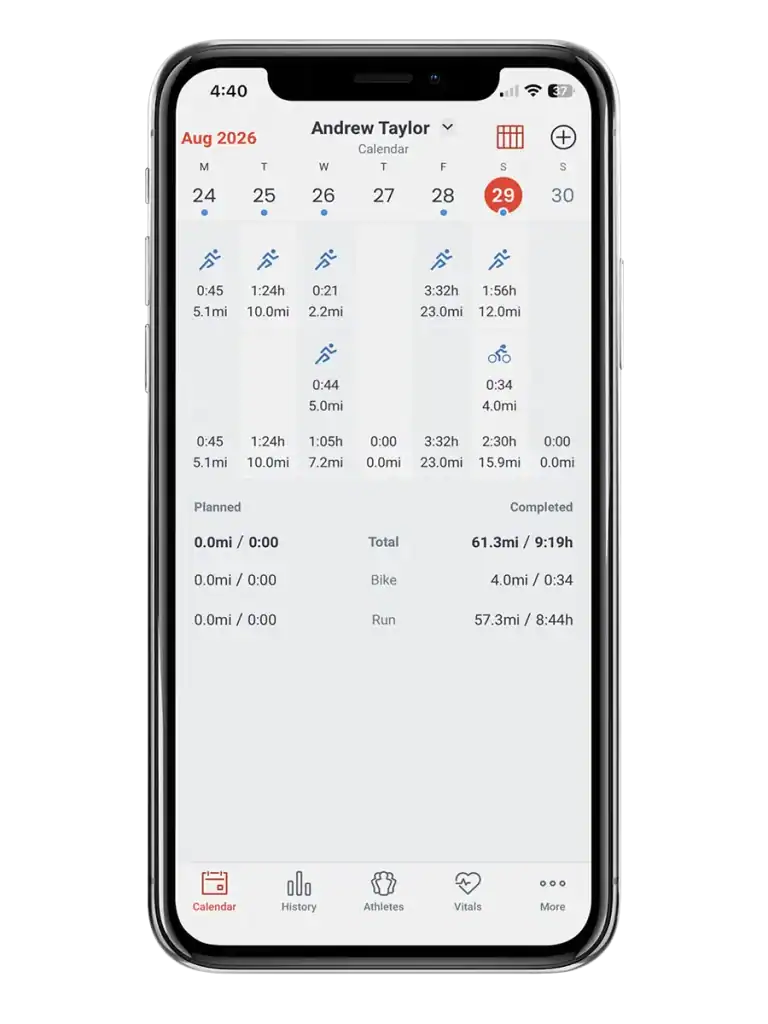
- All 24 weeks, 120 coached runs including race day. Together, the long run and next morning's short run teach you to move well before your legs feel fully recovered.
- 42 strength and mobility sessions of 20 minutes, plus 24 shorter mobility sessions for the rest day.
- Run by effort, not pace. Every session on an RPE 1 to 10 scale. No paces, no heart rate, no zones.
- A coach's note on every run: how it should feel, one cue to hold onto, and how to shorten it when today is not the day.
- One-time purchase, yours for life. Printable PDF, syncs to your watch, delivered through Final Surge.
How It Works
Final Surge is free to use — you’re paying for the plan, not a subscription.
Frequently Asked Questions
You are ready if a completed marathon or marathon build, 5 running days and a comfortable 12-mile long run describe your current training. Those should already be true, not goals for later. Week 1 asks for 32 miles across 5 runs, with a 12-mile Saturday.
Twenty-four miles gives you enough distance for a complete rehearsal without carrying the full cost of a 50K into the taper. The remaining miles come from the fitness built across 24 weeks and the recovery that follows your peak. You reach race day with the rehearsal completed and enough freshness left to use what you built.
No, you can follow the plan on whatever ground you have available. Every run is written by effort rather than terrain. Fueling, hiking and descending are practices you adapt to your own course, so your regular training routes do not need to match the race exactly.
A short run sits on Sunday every week, the morning after the Saturday long run. In Weeks 10 and 14, it becomes a genuine second long run instead of a recovery run. Starting before your legs have fully come back teaches you to move under a condition most marathon plans never ask you to practice.
Skip the missed run and continue with the next scheduled session. Do not stack runs, squeeze a long run into the wrong place, or turn a recovery week into a make-up week. Consistency across the 24 weeks of the plan beats being perfect for 2.
No. Every session is written on an RPE 1 to 10 effort scale. That means the plan works on hills, in heat, on tired legs and at any fitness level, and it keeps working as you get faster.
The 50 Mile is the next step when your next race goes beyond 50K. Repeating this plan is also a real option, because the fitness and practical knowledge from the first build give you a stronger starting point for another race at the same distance.
Move to the Advanced Half if you want another half marathon build and can give training a 6th running day. If you are ready to take the endurance in a different direction, move up to the marathon. The better choice depends on whether you want to keep sharpening 13.1 or start preparing for more distance.

Founder & Head Coach, Sunrise Running Company
Andrew is a USATF Level 1 certified running coach in Modesto, California, with 35+ years of running and 8 finishes at the 100-mile distance. He holds a BS in Exercise Science Education and an MA in Sports Management from Ohio State, and he writes every Sunrise Running plan himself.
24 Weeks To Your 50K Ultra
Pick your race, set your start date, and the plan builds backward from it. If the race moves, the plan moves. You keep it for life, which means the next build starts from something you already know works.
One-time purchase, lifetime access. Delivered instantly through Final Surge.