
You are here:
- Home
- Running Plans
- Marathon Training Plans
- Beginner Half Marathon to Marathon Bridge Plan
Beginner Half Marathon to Marathon Bridge Plan
Written by Andrew Taylor. USATF Level 1 Coach. Coaching runners since 2010.
The marathon on your calendar still belongs in this season.
You have just finished a half marathon build with fitness in hand. You now either have a marathon coming up on the race calendar or you’re wondering, can I run a marathon? The answer is, yes!
Moving from 13.1 to 26.2 asks you to clear the race from your legs, then put the new training where the half marathon build stopped: the long run.
Your training week keeps the same shape from start to finish. Only one run changes character, so the long run can grow without every part of your training changing around it.
- 14 week plan
- 4 runs per week
- 20 to 39 miles a week
- Longest run 20 miles
- 57 coached runs
One-time purchase, yours for life. Delivered through Final Surge.

Before You Start
Consistently run 18 to 22 miles a week, 4 days per week for 30 to 45 minutes on regular runs and 8 miles on a long run. No speed work experience needed. A completed half marathon is required before starting.
Is This You?
If you have 20 weeks and no recent half marathon build, choose the Beginner Marathon. If you run 6 days with a weekly workout, use the Intermediate Half Marathon to Marathon Bridge Plan.
A free 15-minute call can sort out every other starting point.

A Bridge Starts From Existing Fitness
This bridge plan is 14 weeks because it starts from the aerobic base you built and raced on days ago. A full 20-week build would spend its opening stretch creating something you already own.
Your actual gap is a long run that has never moved past 13.1 miles, with race fatigue still sitting in your legs. The first 2 weeks clear that fatigue before we ask anything new from you.
From there, every new demand goes into extending the long run, and nothing else gets added around it. You won’t find track work, tempo or threshold running anywhere in these 14 weeks, and only 2 sessions go beyond steady. That leaves you with a focused marathon build that keeps the rest of your training familiar while preparing you for the distance the half never required.
Or have the plan written as you go
This plan is fixed the day you buy it. A marathon build is not, and neither is the life you are fitting it around. With coaching, Andrew reads what you ran, what hurt and what got in the way, then writes the next 4 weeks against it rather than against a template.
$129.99 a month, no contract.
What Makes A Sunrise Running Plan Different
Most plans tell you how far to run. This one tells you how it should feel, and what to do when it doesn’t.
More on why this Sunrise Running plan runs on effort instead of pace.
A Real Week From The Plan
Week 11 puts the whole build on its longest run, with every weekday supporting it.
| Day | Session | Time | What It Asks For |
|---|---|---|---|
| Monday | Easy Run Plus Strides | 60 minutes | Run easy, then finish with 4 to 6 relaxed strides. |
| Tuesday | Cross Training | 45 minutes | Choose low-impact movement or take the day off. |
| Wednesday | Steady Progression Run | 65 minutes | Run 45 minutes easy, then finish with 20 minutes steady. |
| Thursday | Strength and Mobility for Runners | 15 to 20 minutes | Keep the work controlled before the peak long run. |
| Friday | Recovery Run | 55 minutes | Run at the gentlest effort of the week. |
| Saturday | Long Run | 20 miles | Cover the longest distance in the plan entirely easy. |
| Sunday | Rest and Recovery | Full rest | Leave the day open for recovery. |
| Week total | 39 miles | The peak week and the longest run before the taper begins. |
Every Week Opens With A Note Like This One
Week 6 makes fueling part of the work while the stakes are still low.
Fueling starts to matter this week. Practice it now, while the stakes are low.
The fartlek is a change of texture rather than a step up in effort. Run relaxed pickups by feel with easy running between them: no watch, no structure, nothing that leaves you tired for Saturday. After 4 weeks of steady work it wakes your legs up.
Fourteen miles is where a long run stops being long and starts being an event you have to plan. Take fluid and fuel from the first half hour, on a schedule, before you feel you need it.
Focus this week on:
- Keeping every fartlek pickup controlled and comfortable.
- Fueling every 30 to 40 minutes on Saturday, timed rather than guessed.
- Running Friday genuinely slowly. It is the day before the longest run so far.
One more build week, with 16 miles on Saturday.
You receive 14 weekly notes like this, plus a separate coaching note on every run.
The 14 Weeks, Phase By Phase
| Weeks | Phase | Mileage | What It Does |
|---|---|---|---|
| 1 to 2 | Reset | 20 to 25 miles | The plan opens by recovering from the half you just ran. 4 easy runs a week, nothing faster than steady, and the long run rebuilds from 8 to 10 miles. |
| 3 to 8 | Build | 23 to 33 miles | The long run reaches 16 miles and Wednesday grows into steady and progression work. Recovery weeks at 4 and 8 bracket the block, and Week 6 is where fueling practice starts. |
| 9 to 11 | Peak | 34 to 39 miles | Marathon effort arrives on the long run in Week 9, then 16, 18 and 20 miles across 3 straight weeks. The 20-miler is run entirely easy, because distance is its only job. |
| 12 to 13 | Taper | 24 to 30 miles | Mileage falls 15 miles across 2 weeks while the long run keeps its marathon effort finish, at 14 miles then 10. Strides stay on Monday through both weeks. |
| 14 | Race Week | 14 miles + race | A marathon rhythm run Wednesday, easy running either side, and a 20-minute shakeout Saturday before Sunday's marathon. The only week in the plan without a long run. |
What You Get Inside Training Plan
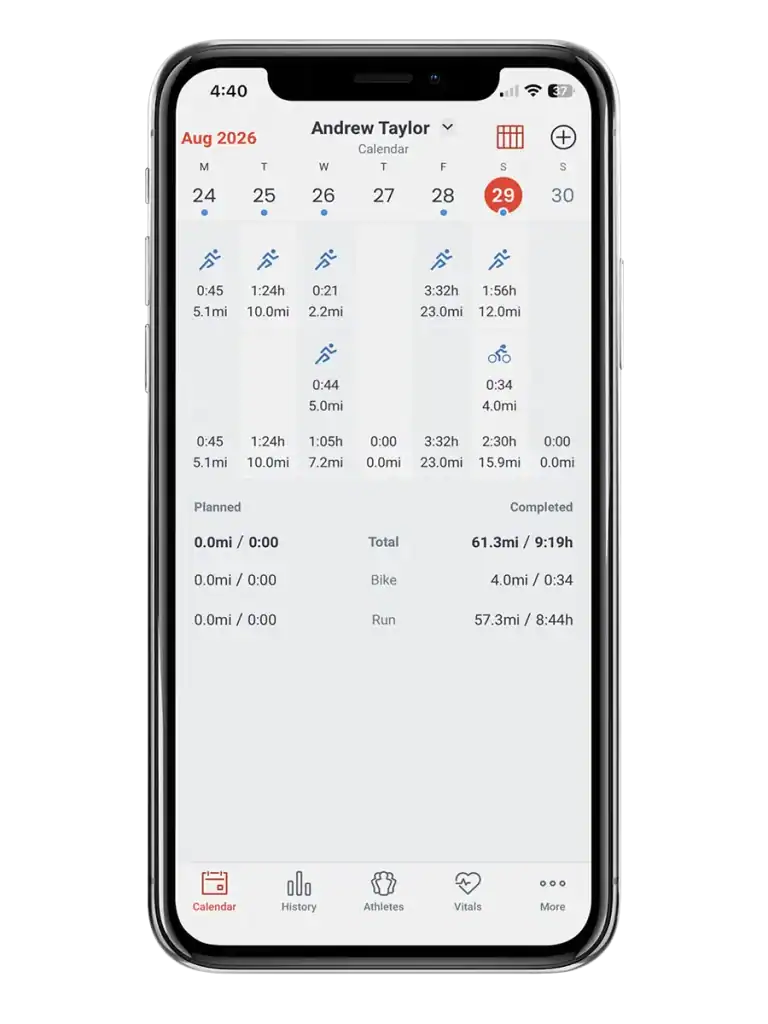
- All 14 weeks, 57 coached runs including race day. The long run progression turns your half marathon base into the endurance needed for a marathon.
- 13 strength and mobility sessions of 15 to 20 minutes, plus 13 optional cross-training sessions of 35 to 45 minutes for anyone who wants a fifth active day.
- Run by effort, not pace. Every session on an RPE 1 to 10 scale. No paces, no heart rate, no zones.
- A coach's note on every run: how it should feel, one cue to hold onto, and how to shorten it when today is not the day.
- One-time purchase, yours for life. Printable PDF, syncs to your watch, delivered through Final Surge.
How It Works
Final Surge is free to use — you’re paying for the plan, not a subscription.
Frequently Asked Questions
You are ready if a recent half marathon or completed half marathon build, 4 running days and an 8-mile long run describe your current training. Those should already be true, not targets for later. Week 1 asks for 3 weekday runs of 30 to 45 minutes and an 8-mile Saturday.
Start the week after your half marathon. Week 1 has no workout and carries less work than the peak of your half marathon build, so it also serves as the recovery week your legs need. You keep the fitness from the race while giving the fatigue underneath it time to clear.
The Beginner Marathon uses 20 weeks to build an aerobic base from the beginning. This plan uses 14 because a recent half marathon build has already supplied that base. Choose between them by looking at your current fitness and the time left before your marathon, not by counting how many marathons you have completed.
The distance itself supplies enough work on a 4-day schedule. Adding a hard finish would extend the recovery from the run without adding enough useful training before the taper begins. You need to absorb the peak long run and move forward, not spend the following week recovering from an effort that arrived too late to help.
Skip the missed run and continue with the next scheduled session. Do not stack runs, squeeze a long run into the wrong place, or turn a recovery week into a make-up week. Consistency across the 14 weeks of the plan beats being perfect for 2.
No. Every session is written on an RPE 1 to 10 effort scale. That means the plan works on hills, in heat, on tired legs and at any fitness level, and it keeps working as you get faster.
Pick your race, set your start date, and the plan builds backward from it. If the race moves, the plan moves. You keep it for life, which means the next build starts from something you already know works.
The Beginner Marathon gives you a full season to prepare when the calendar allows 20 weeks next time. Repeating this bridge after another half marathon is also a real option, because the plan is built for the same starting point: current half marathon fitness and a marathon already approaching.

Founder & Head Coach, Sunrise Running Company
Andrew is a USATF Level 1 certified running coach in Modesto, California, with 35+ years of running and 8 finishes at the 100-mile distance. He holds a BS in Exercise Science Education and an MA in Sports Management from Ohio State, and he writes every Sunrise Running plan himself.
14 Weeks From Your Half To Your First Marathon
Pick your race, set your start date, and the plan builds backward from it. If the race moves, the plan moves. You keep it for life, which means the next build starts from something you already know works.
One-time purchase, lifetime access. Delivered instantly through Final Surge.