
You are here:
- Home
- Running Plans
- Marathon Training Plans
- Intermediate Half Marathon to Marathon Bridge Plan
Intermediate Half Marathon to Marathon Bridge Plan
Written by Andrew Taylor. USATF Level 1 Coach. Coaching runners since 2010.
Carry your strongest season all the way to 26.2.
You have just raced a half marathon with your best fitness still under you. Now the marathon is on the calendar, and you want to reach it without losing the shape you worked for.
This 15-week bridge asks you to recover first, then extend what your current training can support. You are not returning to the beginning or trying to force a full season into the weeks you have.
The structure holds because your weekly workload settles instead of climbing without pause. The long run can keep developing while the rest of your running stays familiar enough to repeat.
- 15 week plan
- 6 runs per week
- 30 to 52 miles a week
- Longest run 20 miles
- 89 coached runs
One-time purchase, yours for life. Delivered through Final Surge.

Before You Start
Consistently run 28 to 34 miles a week, 5 days per week for 45 to 60 minutes on regular runs and 10 miles on a long run. Understanding of marathon effort work. A completed half marathon is required before starting.
Is This You?
If you train 4 days without a weekly workout, choose the Beginner Half Marathon to Marathon Bridge Plan. If you have a full 20 weeks, use the Intermediate Marathon.
A free 15-minute call can sort out every other starting point.

The Plateau Does The Work
This 15-week bridge is built around a plateau because adaptation happens when you meet a demanding week repeatedly, not when you touch one enormous number once. The single peak confirms the work rather than creating it.
From Week 3 through Week 11, the weekly load stays in the high 40s and steps back every third or fourth week. That repetition gives your body time to absorb the training before it has to meet the load again. Climbing toward 3 peak weeks would take recovery you don’t have in a 15-week build, and the benefit would arrive too close to the taper to use.
The total stays nearly level while the long run moves from 14 miles to 20. The increase lands in the session that needs to grow instead of making the entire week larger. You reach the peak with months of work absorbed and one clear step left to take.
Or have the plan written as you go
This plan is fixed the day you buy it. A marathon build is not, and neither is the life you are fitting it around. With coaching, Andrew reads what you ran, what hurt and what got in the way, then writes the next 4 weeks against it rather than against a template.
$129.99 a month, no contract.
What Makes A Sunrise Running Plan Different
Most plans tell you how far to run. This one tells you how it should feel, and what to do when it doesn’t.
More on why this Sunrise Running plan runs on effort instead of pace.
A Real Week From The Plan
Week 12 is the one peak, and the long run carries the marathon-specific work that earns it.
| Day | Session | Time | What It Asks For |
|---|---|---|---|
| Monday | Easy Run Plus Strides | 60 minutes | Run easy, then finish with 5 to 6 relaxed strides. |
| Tuesday | Marathon Effort Intervals, Strength and Mobility for Runners | 80 minutes + 20 minutes | Run 19 minutes easy, then 5 × 6 minutes at marathon effort with 3 minutes easy between, then 19 minutes easy and core work. |
| Wednesday | Recovery Run | 45 minutes | Run noticeably slower than your easy days. |
| Thursday | Easy Run, Strength and Mobility for Runners | 70 minutes + 20 minutes | Keep the effort controlled before the peak long run, then restore mobility without adding more work to your legs. |
| Friday | Easy Run | 45 minutes | Leave enough in your legs for Saturday's finish. |
| Saturday | Long Run With Marathon Effort Finish | 20 miles | Run the first 14 miles easy, then close with 6 miles at marathon effort. |
| Sunday | Rest and Recovery | Full rest | Leave the day open for recovery. |
| Week total | 52 miles | The only peak week, with the longest and most specific run of the plan. |
Every Week Opens With A Note Like This One
Week 1 clears the half marathon from your legs before the workout returns.
Welcome to your marathon bridge. You have just raced a half, and this first week is a reset rather than a build.
The missing Tuesday session is the whole point of this week. Your half marathon fitness is intact; what needs clearing is the fatigue underneath it. Adding intensity 6 days after a race buys nothing and costs the next 3 weeks.
Fifteen weeks is shorter than a standalone marathon plan because you arrive with a base. That only holds if you actually reset first.
Focus this week on:
- Running every session easy, including Saturday’s 10 miles.
- Keeping Wednesday genuinely slower than easy. It is the recovery run.
- Taking Sunday completely off.
- Working backward from your marathon date to confirm the plan lines up.
Marathon training starts properly next week, and the workout returns with it.
You receive 15 weekly notes like this, plus a separate coaching note on every run.
The 15 Weeks, Phase By Phase
| Weeks | Phase | Mileage | What It Does |
|---|---|---|---|
| 1 to 4 | Foundation | 26 to 32 miles | Five runs a week with 2 quality sessions, Tuesday and Thursday, 48 hours apart. The long run grows from 7 to 9 miles and Week 4 steps back to absorb it. |
| 5 to 8 | Build | 31 to 39 miles | Tuesday moves to threshold work and Thursday's steady state run lengthens. The long run reaches 12 miles and Week 8 steps back a second time, which is what makes the peak absorbable. |
| 9 to 10 | Peak | 41 to 43 miles | The biggest 2 weeks of the plan. Week 10 pairs a continuous threshold run with race rhythm work on Thursday and a 14-mile long run, the longest of the plan. |
| 11 | Taper | 29 miles | Volume drops 14 miles but both quality sessions stay, so the legs keep the pace while the fatigue from the peak weeks clears. The fitness is banked, not built here. |
| 12 | Race Week | 16 miles + race | Race rhythm intervals Tuesday, 2 short easy runs, and a 2-mile shakeout Saturday. Enough sharpening to keep the legs awake, not enough volume to cost anything on Sunday. |
What You Get Inside Training Plan
- All 15 weeks, 89 coached runs including race day. The repeated weekly load gives your body time to absorb marathon training before the long run grows again.
- 29 strength and mobility sessions of 15 to 20 minutes, placed on the 2 hardest days so your easy running stays easy.
- Run by effort, not pace. Every session on an RPE 1 to 10 scale. No paces, no heart rate, no zones.
- A coach's note on every run: how it should feel, one cue to hold onto, and how to shorten it when today is not the day.
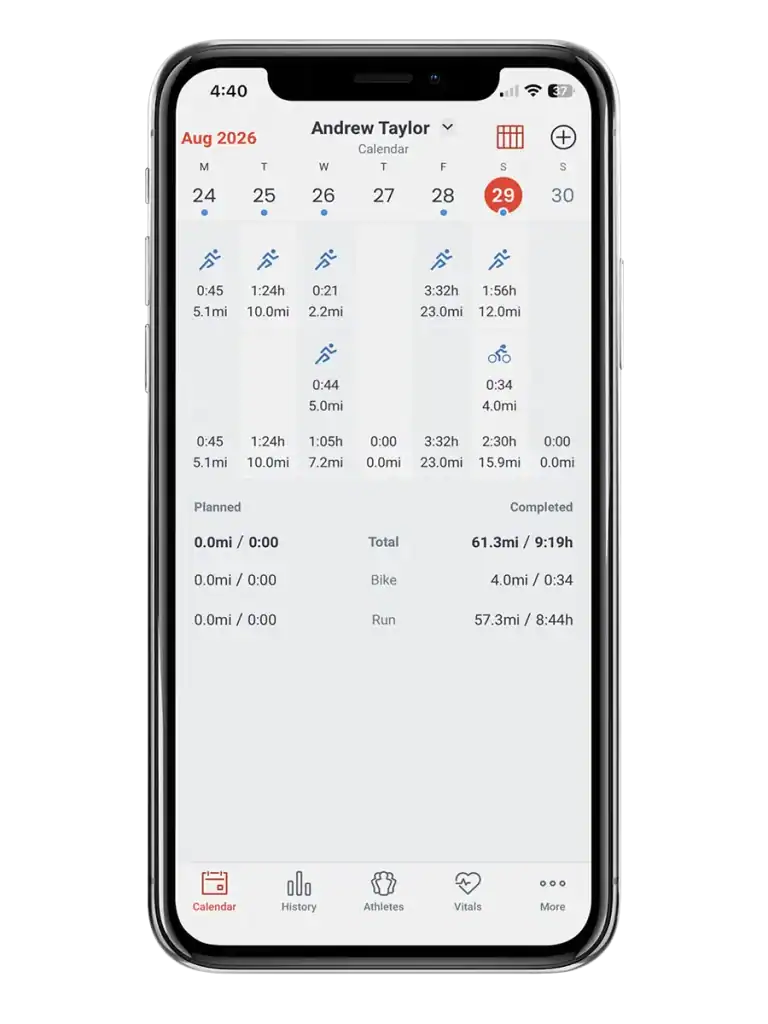
- One-time purchase, yours for life. Printable PDF, syncs to your watch, delivered through Final Surge.
How It Works
Final Surge is free to use — you’re paying for the plan, not a subscription.
Frequently Asked Questions
You are ready if a recent half marathon build, 5 to 6 running days, a weekly workout and a 10-mile long run describe your current training. Those should already be true, not targets for later. Week 1 asks for 5 easy runs and a 10-mile Saturday, with no workout.
Start the week after your half marathon. Week 1 leaves out the Tuesday workout so the race can clear from your legs before intensity returns. You keep running, but every session stays easy and the week remains smaller than the work you just completed. The workout comes back after that recovery has had time to land.
The Beginner Bridge uses 4 running days and no weekly workout across 14 weeks. This plan uses 6 days from Week 2 onward and brings back a workout every Tuesday. Choose between them based on whether your current training already includes that frequency and regular quality work.
One peak week is enough because the repeated high-volume weeks before it create the adaptation. Your body meets a similar workload several times, with recovery weeks placed between those stretches, while the long run keeps growing. The peak becomes the final expression of work you have already absorbed rather than a late attempt to create new fitness.
Skip the missed run and continue with the next scheduled session. Do not stack runs, squeeze a long run into the wrong place, or turn a recovery week into a make-up week. Consistency across the 15 weeks of the plan beats being perfect for 2.
No. Every session is written on an RPE 1 to 10 effort scale. That means the plan works on hills, in heat, on tired legs and at any fitness level, and it keeps working as you get faster.
Pick your race, set your start date, and the plan builds backward from it. If the race moves, the plan moves. You keep it for life, which means the next build starts from something you already know works.
The Intermediate Marathon gives you a full 20-week season when the calendar allows it next time. Repeating this bridge after another half marathon is also a real option, because the same structure can start from the fitness left by a new race and training block.

Founder & Head Coach, Sunrise Running Company
Andrew is a USATF Level 1 certified running coach in Modesto, California, with 35+ years of running and 8 finishes at the 100-mile distance. He holds a BS in Exercise Science Education and an MA in Sports Management from Ohio State, and he writes every Sunrise Running plan himself.
15 Weeks From Your Half To Your Marathon
Pick your race, set your start date, and the plan builds backward from it. If the race moves, the plan moves. You keep it for life, which means the next build starts from something you already know works.
One-time purchase, lifetime access. Delivered instantly through Final Surge.