

Most of the miles in a long-distance training plan should be comfortable. Whether you are preparing for a half marathon, marathon, or ultramarathon, easy running builds the endurance you will rely on during the final miles of your race.
That does not mean every run should be slow.
Even though I mainly compete in ultramarathons nowadays, you can still find me spending time on the track. Speed workouts help me maintain leg turnover, improve running economy, and become more comfortable changing pace when I am already tired.
When it comes to speed training, I find that there are two camps of runners. Some have regularly completed speed workouts and experienced how much they can contribute to a training plan. Others have never tried them, have completed them too aggressively, or have not included them consistently enough to see the benefits.
For runners in that second group, training at a faster pace can seem counterintuitive when the goal is to run for hours. Through my own racing and coaching, however, I have learned that including variety in your training paces is critical for success.
Speed work is one part of that full range of training paces. Depending on your race and where you are in the training cycle, it can work alongside tempo runs, steady-state running, easy miles, and long runs.



Why Include Speed Workouts?
- Speed workouts can improve your ability to use oxygen. Short, fast repeats challenge your aerobic system in a different way than easy and steady running. Improving that system can help you sustain faster paces with less effort.
- Faster running can improve your running economy and form. When you run fast without sprinting, you practice producing more force, maintaining quicker turnover, and moving efficiently. Those improvements can benefit you even when you return to marathon or ultramarathon pace.
- Short and fast repeats break up your training routine. Most of your weekly mileage will still be completed at a slow and steady pace to build endurance. A carefully planned speed workout adds variety without replacing the aerobic work your race requires.
- You gain comfort and confidence at race pace. Many speed workouts include intervals faster than your goal race pace. When you later settle into half marathon or marathon pace, it can feel more controlled and familiar.
- You learn to hold your form while tired. The final repetitions of a workout require concentration. Practicing good posture, relaxed shoulders, and consistent pacing as fatigue develops can prepare you for the later stages of a race.
How to Perform Speed Workouts
A track is a convenient place to complete speed workouts because the distances are clearly measured and you do not have to stop for traffic. However, you can also run intervals on a flat road, paved path, or gently rolling route when a track is not available.
The workouts below use intervals ranging from 400 meters to one mile. The shorter repetitions emphasize turnover and controlled speed, while the longer repetitions give half marathon and marathon runners more time at a sustained hard effort.
Before starting, complete an easy warm-up and give your body time to settle into the session. The first repetition should feel controlled rather than becoming the fastest one of the day.
Your goal is to run the prescribed effort consistently. If your pace drops sharply, your form begins to break down, or you have to sprint to hit the target, end the workout or reduce the remaining volume.
400-Meter Repeats
Warm-up: We encourage you to warm up for 1-3 miles at an easy running pace before starting this 400m repeat workout.
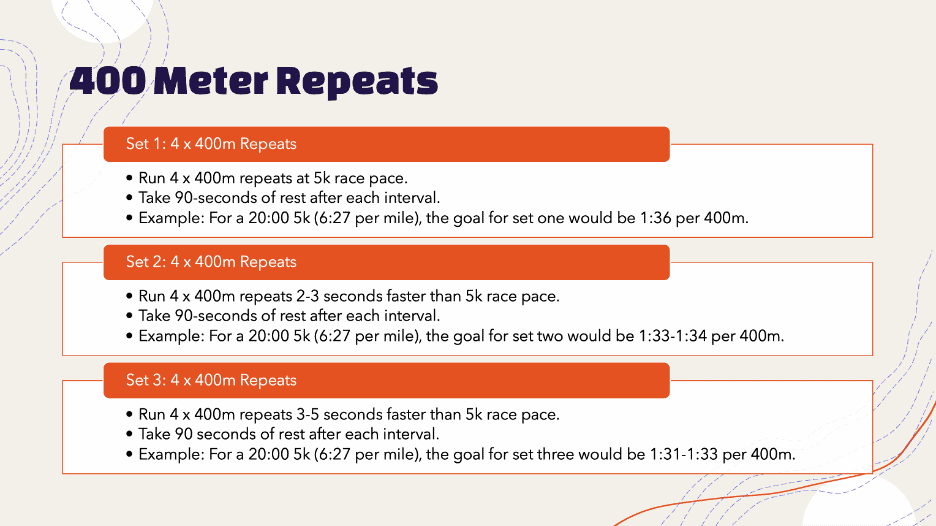
Set 1: Run 4 x 400m repeats at 5k race pace. After every 400m hard run, take 90-seconds of rest. Example: For a 20:00 5k (6:27 per mile), the goal for set one would be 1:36 per 400m.
Set 2: Run 4 x 400m repeats 2-3 seconds faster than your 5k race pace. After every 400m hard run, take 90-seconds of rest. Example: For a 20:00 5k (6:27 per mile), the goal for set two would be 1:33-1:34 per 400m.
Set 3: Run 4 x 400m repeats 3-5 seconds faster than your 5k race pace. After every 400m hard run, take 90-seconds of rest. Example: For a 20:00 5k (6:27 per mile), the goal for set three would be 1:31-1:33 per 400m.
Cool-Down: We encourage you to cool down for 1-2 miles at an easy running pace after completing this 400m repeat workout.
This type of speed workout sets you up for success on race day. How often do you go out too fast or slow in a race? The first set of 400m repeats here teaches you to dial in on race pace right away. How often do you lose focus on your pace during the middle or end of a race? The second and third sets help you stay focused and teach the body not to slow down as the fatigue builds up throughout the race.
Adapting this 400-meter workout: If your training volume is not quite enough to manage 12 x 400m right now, then scale this workout down. For example, complete 6 x 400m repeats, breaking them into 3 sets of 2 x 400m.
800-Meter Repeats
Warm-up: We encourage you to warm up for 1-3 miles at an easy running pace before starting this 800m repeat workout.
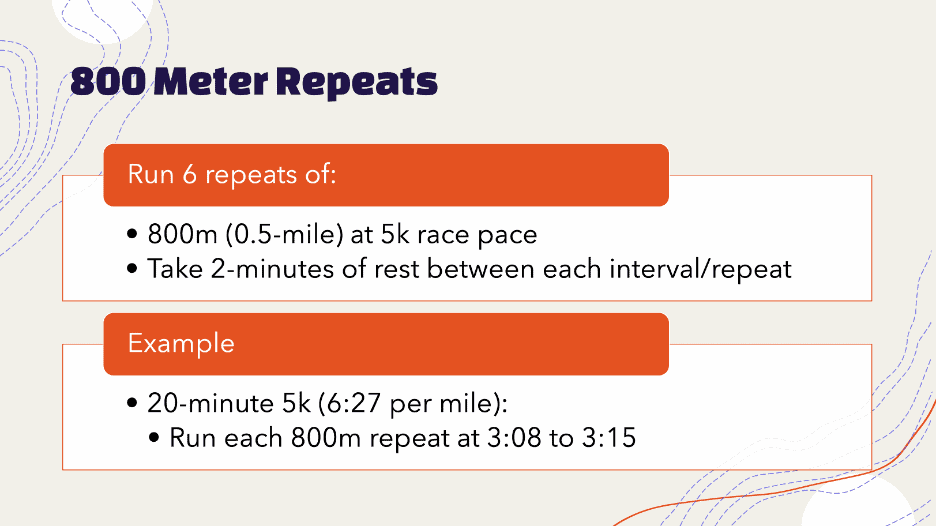
Workout: Run 6 x 800m repeats at 5k race pace. After every 800m hard run, take 2-minutes of rest. Take an extra 1-minute of rest after the third 800m repeat. Example: For a 20:00 5k (6:27 per mile), the goal for set one would be 3:08 to 3:15 per 800m.
Cool-Down: We encourage you to cool down for 1-2 miles at an easy running pace after completing this 400m repeat workout.
Adapting this 800-meter workout: If your training volume is not quite enough to manage a 6 x 800m speed workout right now, then scale this workout down. For example, complete 4 x 800m repeats. You can also follow the guide below as to when you should decrease or increase this workout volume.
- Beginner: 3 to 4 x 800m repeats
- Intermediate: No more than 6 x 800m repeats
- Advanced: Progress up to 8 x 800m repeats
Those levels map to our Intermediate 5K and Advanced 5K plans, which build interval volume across 10 weeks instead of leaving you to judge it session by session.
As you gain experience, speed, and strength, add variation to this workout by either decreasing the rest time between each repeat or increasing the pace as you complete the workout.
Mile Repeats for Half Marathon and Marathon Training
Mile repeats give long-distance runners a different challenge than 400- or 800-meter intervals. You are still running faster than your normal easy pace, but each repetition lasts long enough that pacing, patience, and aerobic strength become more important.
This is not an all-out mile test. Start at an effort you can repeat without a significant slowdown, then try to make the final repetition as controlled as the first.
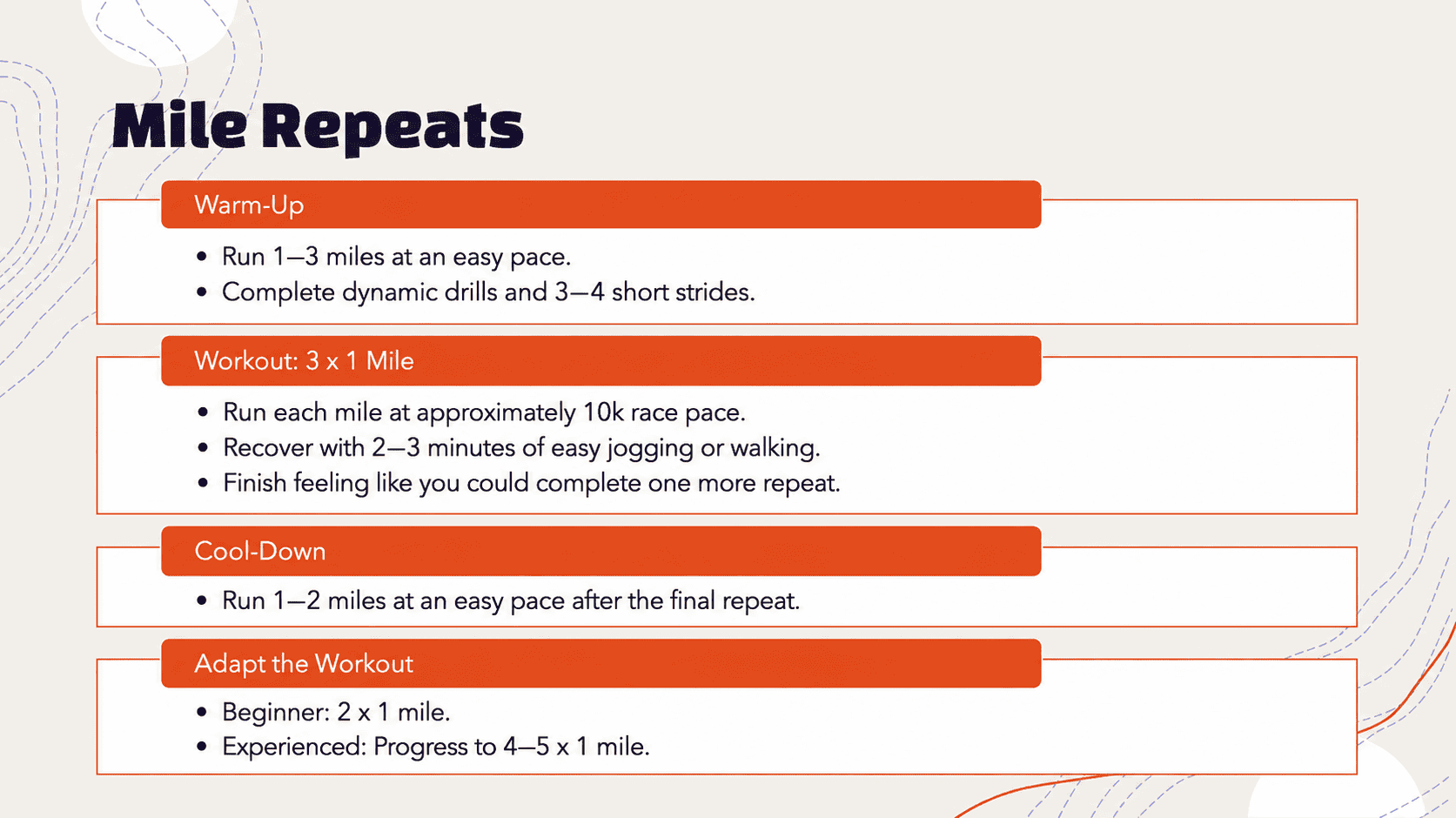
Warm-up: Run 1-3 miles at an easy pace. Follow the run with a few dynamic drills and 3-4 short strides before beginning the first mile.
Workout: Run 3 x 1 mile at approximately 10k race pace. Recover with 2-3 minutes of easy jogging or walking after each repeat.
If you are preparing for a half marathon or marathon and do not have a recent 10k result, use a comfortably hard effort that you could sustain for roughly an hour in a race. Each repetition should feel challenging, but you should finish knowing you could complete one more if the workout required it.
Cool-Down: Run 1-2 miles at an easy pace after completing the final repeat.
Adapting this mile-repeat workout: Begin with 2 x 1 mile if you are new to longer intervals or currently running lower weekly mileage. More experienced runners can progress to 4-5 x 1 mile, but the added volume should fit the rest of the training week rather than compromising the next long run.
You can also make the workout more race-specific by slowing the pace slightly and shortening the recovery. For example, a marathon runner might complete 4 x 1 mile between half marathon and 10k effort with a controlled two-minute jog instead of treating every repeat like a race.
How Many Speed Workouts Do You Need Each Week?
For most runners preparing for a race, one speed session per week is enough. That gives you a regular dose of faster running while leaving room for the easy mileage and long runs that build your endurance.
A typical training week might include one interval workout and one tempo or steady-state day. Keep at least one easy or rest day between those harder sessions, and avoid placing a demanding speed workout immediately before or after your long run.
The complete week matters more than any individual workout. If adding speed work causes you to struggle through your long run, miss easy days, or carry soreness from one session to the next, reduce the number of repetitions or alternate speed workouts with tempo work from week to week.
Your training history should also guide the decision. A runner who has completed intervals consistently may tolerate more volume than someone introducing speed work for the first time during a race build.
As race day approaches, begin reducing the volume of your speed workouts along with your overall mileage. You can keep a few short, controlled repetitions during the taper to maintain leg turnover, but this is not the time to add a harder workout or test your fitness.
The goal during the final weeks is to arrive rested while keeping your legs familiar with race pace. You will not gain much fitness from one last demanding interval session, but you can carry unnecessary fatigue into race day.
Stay Motivated Through Training
Speed workouts are just one part of becoming a stronger runner. Keep your motivation high with gear that reflects your journey:
A Training Plan That Works for You
Our collection of running plans can help you bring your speed workouts, long runs, recovery days, and race-specific training together. We offer plans for distances from the 5k through the 100-mile ultramarathon, with options for different experience levels and goals.
Instead of trying to fit individual workouts together on your own, start with a complete schedule built around your race distance. View our running plans here.