
Do You Need Tempo Runs in Your Training Plan?
A tempo run is a sustained effort at RPE 5 to 6. It should feel comfortably hard and controlled, not like a race or an all-out test.
Tempo runs are a staple for many intermediate and advanced long-distance runners because they build the ability to maintain a strong effort without fading. You work hard enough to create a useful training response, but not so hard that the session falls apart before the scheduled work is complete.
I’ve included tempo sessions throughout my running career, but I can’t say I’ve always done them correctly. The most common mistake is turning comfortably hard into the hardest effort you can produce that day. A tempo run should leave you feeling as though you worked with purpose, not as though you raced the workout.
Do you need one? Not every runner needs tempo work immediately. If you’re still building a consistent running routine, easy running and gradual increases in time on your feet come first. Once that foundation is in place, tempo sessions can help you prepare for the longer, controlled efforts that racing asks of you.
What Are the Benefits of Tempo Sessions?
Improve Your Lactate Threshold
Your body produces lactate during running and can use it as fuel. As the effort rises, lactate production increases. At easier efforts, your body can process it without much trouble. At harder efforts, production eventually rises faster than your body can manage it, and fatigue builds quickly.
Your lactate threshold sits near the point where that balance becomes difficult to maintain. Tempo training keeps you just below that point. Over repeated sessions, your body becomes better at processing the byproducts of harder running and sustaining the work before fatigue forces you to back off.
The key word is controlled. Starting the session at threshold effort changes it entirely. You tire sooner, your form may begin to break down, and you lose the sustained work that makes a tempo run useful. Staying at RPE 5 to 6 lets you accumulate enough quality time without turning the workout into a race.
Increase Your Running Efficiency
Tempo runs teach your body to settle into a strong effort and hold it. You aren’t repeatedly surging, slowing down or reacting to every small change in how you feel. You’re practicing steady work while fatigue gradually develops.
That control matters. The more familiar the effort becomes, the less energy you waste fighting it. You learn to relax your shoulders, keep your breathing under control and maintain your form without forcing every step.
Running efficiency isn’t just about moving faster. It’s also about using your effort well. A properly run tempo session helps you do more work before the same effort begins to feel overwhelming.
Develop Your Mental Strength
Tempo running puts you in the middle ground between comfortable running and an all-out effort. You know you’re working, and you also know you need to remain patient.
That creates useful mental practice. When the session becomes uncomfortable, your job isn’t to panic, surge or quit. You check your effort, settle your breathing and continue with control.
Those decisions carry into racing. Difficult thoughts often show up before your body truly needs to stop. Tempo sessions give you regular chances to notice those thoughts without automatically responding to them. You learn the difference between discomfort you can manage and an effort that has become too hard for the purpose of the day.
Prepare Yourself for an Upcoming Race
Racing asks you to make good decisions while working hard. A tempo run gives you a place to practice that skill without the pressure of a finish time or another runner beside you.
You learn how a sustainable, comfortably hard effort develops. The opening minutes should feel controlled. The middle requires attention. Near the end, you’re working hard, but you can still maintain the same effort without straining or sprinting.
This is especially useful when your goal race asks you to hold an effort above tempo for an extended period. During half marathon training, tempo sessions build the control and endurance you’ll need before progressing to the stronger effort the race demands. The workout develops judgment as much as fitness.
How Do You Find Your Tempo Effort?
Tempo and Threshold Are Not the Same Effort
Tempo and threshold are often used interchangeably, and I used them that way for years. In Sunrise plans, they are neighboring efforts, not synonyms. Tempo is RPE 5 to 6, comfortably hard. Threshold sits just above it at RPE 6 to 7, the effort you could hold for about an hour if you had to. The 5-session progression later in this post begins at tempo effort. As the intervals grow longer, the final sessions push toward threshold. That change is the reason to complete the sessions in order.
Your breathing gives you an immediate check. You should be able to speak a few words at a time, but not carry on a full conversation. If you can talk comfortably in complete sentences, the effort is too easy. If you’re counting down every minute and wondering whether you can finish the next one, it’s too hard.
For most runners, tempo effort falls near the pace they could race for 10K to 15K. Treat that as a familiar landmark, not a target. The number on your watch will move with heat, hills, wind and the way your training week has gone.
The effort is the target, while the number on your watch gives you useful feedback. Your speed at RPE 5 to 6 will change on a hot day, over hills, into the wind or late in a demanding training week. That isn’t a failed workout. Adjusting your speed is how you keep the session at the correct effort when conditions change.
Start the first interval with restraint. Tempo work should become demanding as the session continues, not feel desperate from the first few minutes. If your effort keeps climbing even though you’re slowing down, end the tempo portion early or switch to easy running. Forcing the final interval won’t restore the purpose of a session that has already drifted above tempo effort.
How Do You Build Tempo Runs Into Your Training?
Tempo sessions are demanding both physically and mentally, so 1 tempo session per week is the maximum. You need enough easy running and recovery around the workout to absorb it.
If tempo running is new to you, don’t begin with one long, continuous effort. Short intervals let you learn what RPE 5 to 6 feels like while the recovery jogs keep the workout manageable. As the sessions progress, the tempo intervals become longer or the recovery becomes shorter.
Include easy running before the first interval so your body has time to warm up. After the final interval, finish with more easy running. The warmup and cooldown are part of the session, not optional mileage added around it.
Use this 5-session progression gradually. Complete no more than 1 session each week, and repeat a session before moving forward if you can’t keep the tempo portions controlled.
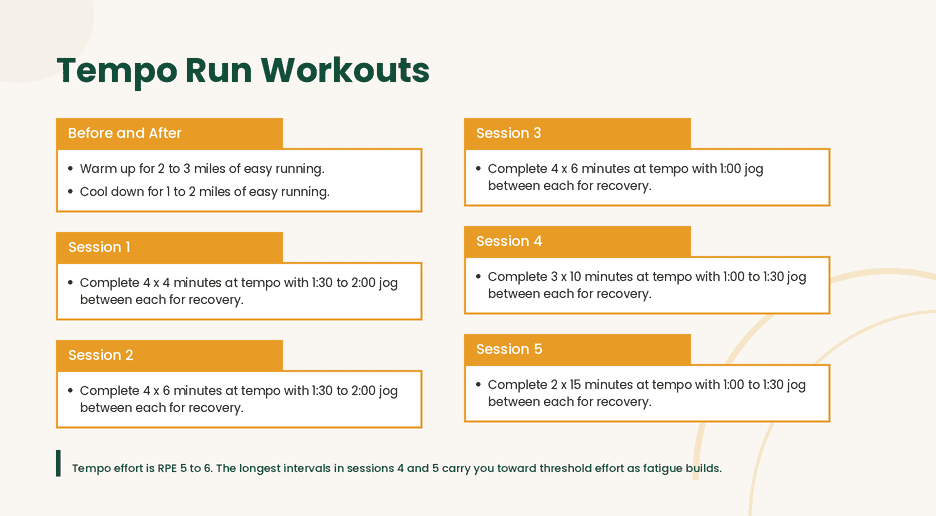
Session 1
4 x 4 minutes at tempo with 1:30 to 2:00 jog between each
Session 2
4 x 6 minutes at tempo with 1:30 to 2:00 jog between each
Session 3
4 x 6 minutes at tempo with 1:00 jog between each
Session 4
3 x 10 minutes at tempo with 1:00 to 1:30 jog between each
Session 5
2 x 15 minutes at tempo with 1:00 to 1:30 jog between each
The longest intervals in sessions 4 and 5 carry you from tempo up toward threshold effort as fatigue builds, which is the intended progression, not a sign you ran too hard.
Final Thoughts on Tempo Runs
A good tempo run doesn’t prove how hard you can push. It shows that you can reach a demanding effort, settle into it and stay in control.
Once you can complete the longer sessions at the intended effort, you can alternate shorter and longer tempo intervals based on the goal of your training week. You don’t need to make every session longer or harder. Repeating a familiar workout with better control is progress.
Pay attention to how the effort develops from the first interval to the last. If RPE 5 to 6 feels noticeably different than usual, that information matters. Heat, accumulated fatigue, poor sleep and stress can all change what you’re ready to handle that day. Training by effort lets you respond without abandoning the purpose of the workout.
Put Tempo Work in the Right Place
A tempo session is only useful when it fits the rest of your week. Place it too close to another demanding workout or a long run, and you may carry fatigue into both. Add it before you’ve built enough easy running, and the workout can take more from you than it gives back.
A structured plan decides when tempo work belongs, how it progresses and what should surround it. Explore our running plans to find a schedule that brings tempo sessions, easy running, long runs and recovery together around your race goal.