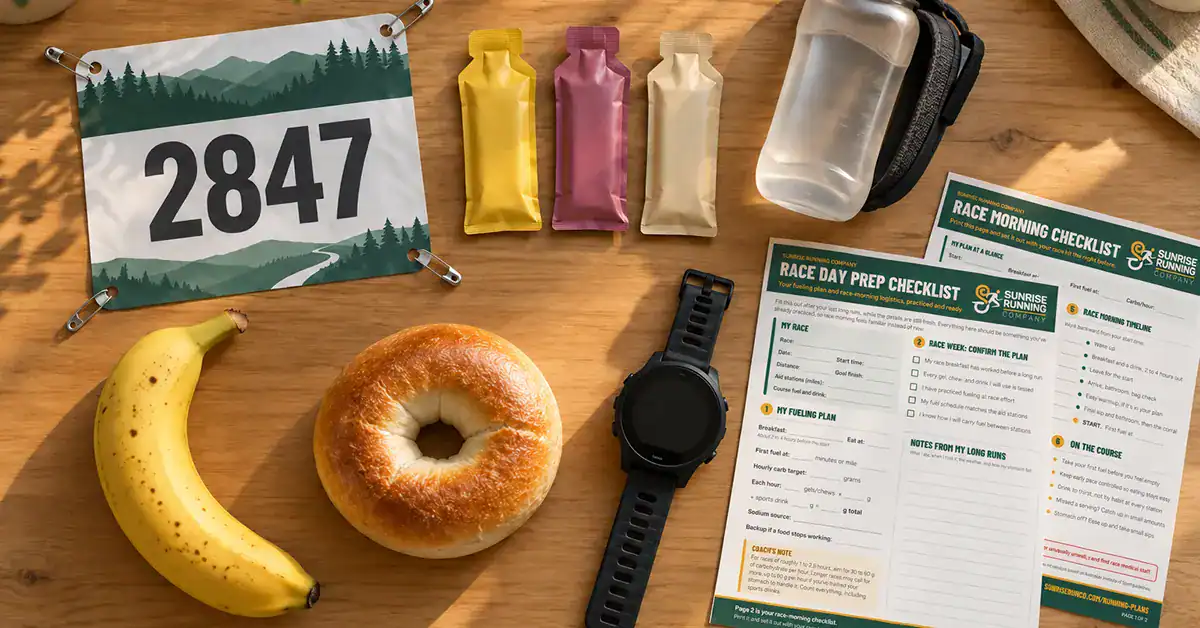
You’ve done the long runs. You know your goal pace. Then race week arrives, and suddenly you’re wondering how many gels to carry, whether to drink at every aid station, and what to eat before an early start.
Those are good questions. I’d rather have you ask them during training than answer them for the first time at mile 18.
Your race-day fueling and hydration strategy should be something you’ve practiced: what you’ll eat before the start, how you’ll take in fuel and fluids along the course, and what you’ll do when conditions change. The longer the race, the more chances you have to get behind. Let’s build a plan you can rehearse.
Practice Your Fueling Before Race Day
A long run is more than a test of your legs. It’s your chance to learn whether breakfast sits well, whether you can open a gel while moving, and whether your planned intake still works several hours in.
Start with a familiar breakfast before a long run. Carry the fuel you expect to use in the race, and follow a schedule instead of waiting until you feel drained. Afterward, write down what you ate and drank, when you took it, the weather, and how your stomach felt. Repeat the parts that worked. Change one thing at a time when something didn’t.
Practice at a similar effort, too. A gel that feels fine on an easy run may feel different when you’re pushing to hold marathon pace. If you’re still working out how your training effort relates to race effort, my guide to training paces can help you plan those rehearsals.
Check the race website for aid-station locations and what they’ll serve. If you want to use the course’s sports drink or gels, test the exact products in training. If they don’t work for you, plan how you’ll carry your own. Race morning is too late to find out that the flavor, concentration, or packaging is a problem.
What to Eat and Drink Before the Race
The Night Before
You don’t need an enormous pasta dinner. You need a familiar meal with carbohydrate, enough food to feel satisfied, and time to digest before bed. Rice, potatoes, pasta, or bread can all fit. Choose the foods and portions that have worked before your long runs.
If a big salad, spicy meal, or heavy dessert tends to upset your stomach, save it for another night. The same goes for drinking more water than usual in an attempt to get ahead. Drink regularly through the day and with your meals; avoid arriving at the start feeling bloated.
Set out breakfast, bottles, gels, and anything you’ll carry before you go to bed. That removes decisions from an already early morning.
Race Morning
Give yourself time to eat a familiar, carbohydrate-rich breakfast and let it settle. For many runners, that means eating about 2–4 hours before the start. Toast, a bagel, oatmeal, a banana, or a combination may work, but your long-run rehearsals should decide what goes on your plate.
An early start can make a full breakfast difficult. If that’s your situation, practice a smaller meal or snack closer to the start and account for it in your early-race fueling plan. Don’t force down a meal you haven’t tested just because it sounds right on paper.
Drink with breakfast, then sip as needed before the gun. Consider the weather and your access to water, but don’t try to store up fluid by drinking large amounts at once. Your goal is to start comfortably hydrated, with a plan for drinking as you run.
Fueling and Hydration During the Race
Plan intake by time on your feet, then use course landmarks or watch alerts to help you follow it. A fast half marathon and a 3-hour half marathon call for different plans, even though both cover 13.1 miles.
For endurance events lasting roughly 1–2.5 hours, the Australian Institute of Sport’s carbohydrate intake guidelines for sporting activities recommend 30–60 grams of carbohydrate per hour. Longer events may call for more, with up to 90 grams per hour used by runners who have trained to tolerate that intake. These are planning ranges, not a requirement to hit the highest number. Count carbohydrate from sports drink as well as gels, chews, and food.
Half Marathon: Keep the Plan Simple
If you expect to run for around 2 hours or longer, practice taking in carbohydrate during the race. A gel, chews, or sports drink can work. Choose a first fueling point early enough that you’re taking fuel while you still feel good, then decide whether you’ll need another serving based on your expected finish time.
For a shorter half marathon, the breakfast you’ve practiced may do more of the work. You can still rehearse a small amount of fuel if it fits your plan. Don’t copy another runner’s gel schedule without considering how long you’ll be out there.
Know which aid stations offer water and which offer sports drink. Take fluid according to conditions and what you practiced, rather than automatically emptying a cup at every stop.
Marathon: Start Early and Stay Consistent
A marathon gives you plenty of time to fall behind on fuel. Build a schedule around regular carbohydrate intake, starting early in the race. If a gel provides 25 grams of carbohydrate, for example, 2 gels over an hour provide 50 grams. If you also drink a carbohydrate-containing sports drink, count that toward your total.
Practice the whole sequence on long runs: when you take each serving, how much fluid you drink with it, and where you carry the next one. Check your race’s aid-station map against your schedule. If there’s a long gap between stations, you may need to carry fluid or adjust where you take a gel.
Keep your early pace under control. Running harder than planned can make eating and drinking feel less appealing just when you need to establish a rhythm.
Ultra: Plan for Hours, Terrain, and Changing Appetite
In an ultra, your fueling plan has to last beyond the window covered by most marathon long runs. Set an hourly carbohydrate target you’ve practiced, then divide it into manageable portions. For some runners, gels and sports drink remain useful. Others want familiar solid food as the hours pass. Test those choices on long runs and race-specific outings.
Pace matters here. A steep climb, technical descent, or long stretch between aid stations may change when it’s practical to eat. Look at the course profile and station distances, then decide what you’ll carry between stops. If you use a drop bag or crew, write down what goes where.
Build flexibility into the plan without losing track of intake. If one food stops appealing to you, have another tested option. If you realize you’ve missed a serving, return to your schedule in manageable amounts instead of trying to make it all up at once.
How Much Should You Drink?
There isn’t one fluid amount that fits every runner or every race. Heat, pace, sweat rate, aid-station spacing, and what you carry all matter. Use your training runs to learn how often you tend to drink and how that changes in warmer conditions. Drink to thirst, with your rehearsed plan and the day’s conditions in mind; avoid forcing down large amounts of water.
For longer races, especially in heat, pay attention to sodium as part of your fluid plan. Sports drinks and some foods contain it; plain water does not. Check labels so you know what your products provide. Sodium can help you plan for prolonged sweating, but it doesn’t make overdrinking safe.
Common Race-Day Fueling Mistakes
Eating far more fiber than usual before the start. A large serving of high-fiber food may sound healthy but leave your stomach working hard during the race. Choose the breakfast you’ve tested, and be careful with unfamiliar foods the night before.
Trying a new gel on the course. Flavor, texture, ingredients, and how much water you take with it can all affect how a product feels. Test the exact fuel you plan to carry or take from an aid station.
Ignoring electrolytes during a long race. If you’ll be out for hours, especially in warm weather, know whether your drink and food provide sodium. Make that part of your tested plan instead of grabbing a product you’ve never used at the last station.
Waiting until you feel empty to start fueling. Hunger and fading energy are late reminders. Put the first serving on your schedule, then keep checking in with it.
Copying a plan without counting everything in it. A gel plus sports drink may deliver more carbohydrate than you realize. Read the labels and add up what you expect to take each hour.
Race-Day Fueling FAQ
Choose the timing during training and take it before you feel depleted. For a marathon or ultra, that usually means beginning your fueling schedule early rather than waiting until the middle of the race. Your breakfast, expected finish time, and the carbohydrate in any sports drink all affect the plan.
You may benefit from fuel during a half marathon, particularly if you expect to be running for about 2 hours or more. A gel isn’t the only option: chews or sports drink may be easier for you to use. Practice your choice before race day.
Yes, if you know what it is and have tested it. Find out which stations serve it, check how much carbohydrate and sodium it contains, and include it in your hourly intake. If the race changes products or you can’t confirm what’s served, carry a familiar option.
Not automatically. Start by checking the sodium in the drinks and foods you’ve practiced with, then consider the conditions and how long you’ll be racing. Don’t add tablets for the first time on race day, and don’t use them as a reason to drink beyond thirst.
Ease your effort and assess what you’ve taken in: fuel, fluid, and any unfamiliar products. Small, manageable sips or portions may be easier than forcing a large serving. If symptoms are severe or you feel confused, faint, or unusually unwell, stop and seek help from race medical staff.
Make the Plan Part of Your Training
Write down your breakfast, your first fueling point, what you’ll take each hour, and where you’ll get fluid. Then rehearse the plan on long runs. You’ll learn more from a real test than from the neatest schedule you can write at your desk.
If you’re building toward a half marathon, marathon, or ultra, our running plans give you a structure for the training that surrounds those rehearsals.
Get the Free Race Day Prep Checklist
Fueling is only part of a smooth race morning. The Race Day Prep Checklist puts your fueling plan and race-morning logistics on one printable page, from breakfast and what to carry to your start-line timeline.
Your fueling plan and race-morning logistics on 2 printable pages: one to fill out after your long runs, and one to set out with your race kit the night before.
You’ll also get training tips from Sunrise Running Company. Unsubscribe anytime.