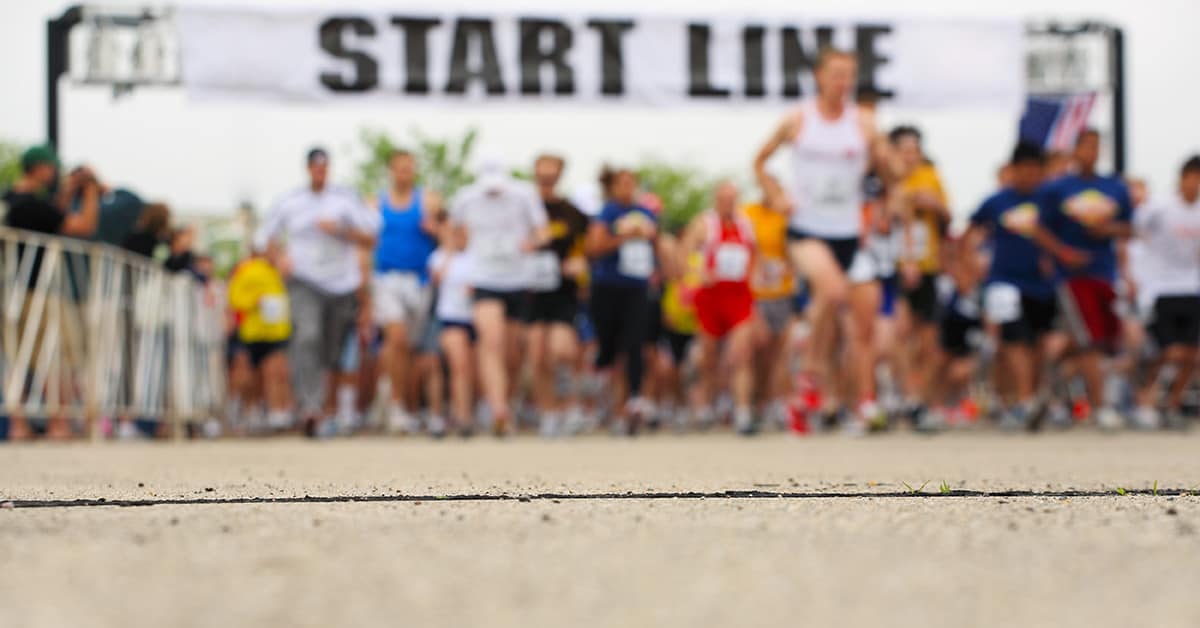

Most runners have started a race too fast at least once. You feel rested, the crowd is moving, and the pace that seemed challenging in training suddenly feels surprisingly easy.
Then the race catches up with you.
Your breathing becomes harder than expected, your pace begins to slip, and the final miles turn into an attempt to limit the damage. It is easy to blame your fitness when this happens, but the problem often began with the decisions you made during the opening minutes.
Pacing discipline can decide a race just as much as fitness. Training determines what you are capable of running. Your race pace strategy determines how much of that fitness you can actually use.
Learning how to pace a race does not mean following your watch every second. It means choosing a realistic goal, controlling your early effort, and giving yourself the opportunity to run well when the race becomes difficult.
Why Runners Start Races Too Fast
The first mile of a race rarely feels like the first mile of a normal run. You have tapered or reduced your training, completed a warm-up, and spent several minutes waiting for the start. Once the gun goes off, your body is ready to move.
You are also surrounded by runners who may have completely different goals. Some belong ahead of you. Others are making the same pacing mistake you are trying to avoid.
Several factors make a fast start especially tempting:
- Adrenaline: Race-day nerves and excitement can make a quick pace feel easier than it is.
- Crowd energy: It is natural to match the runners around you instead of settling into your own effort.
- A downhill opening: An early descent can produce fast splits without immediately feeling difficult.
- Fresh legs: Goal pace should feel controlled at the beginning. That can create the false impression that you should be running faster.
- Time lost in congestion: After a crowded start, runners sometimes surge to make up a few seconds much earlier than necessary.
The problem is that the opening mile does not tell you whether your pace is sustainable. Almost any realistic race pace will feel manageable while you are rested. The better question is whether that effort will still be manageable after you have covered most of the distance.
If goal pace feels almost too easy during the first mile, that is often a sign that you are pacing correctly.
Know Your Goal Pace Before Race Day
You cannot build a reliable pacing plan around a goal that is not connected to your current fitness.
A goal pace should come from recent training and race performances, not simply the finish time you would like to run. Ambitious goals can be useful, but choosing a pace that your current fitness does not support usually turns the race into a test of how long you can hold on.
Before race day, use the Sunrise Running Company Running Calculator to convert a recent race performance into predicted times and paces for other distances. This gives you a practical starting point for choosing your goal pace.
For example, you can enter a recent 5K or 10K result and review the predicted pace for an upcoming half marathon. The prediction is not a guarantee, but it is much more useful than choosing a finish time without considering what you have run recently.
The calculator also shows pace per mile and kilometer, allowing you to write down the splits you will need before the race. If you want a broader explanation of goal pace, endurance pace, tempo pace, and other training zones, read our guide to understanding your training paces.
Even Splits vs. Negative Splits
Most race pace strategies fall into one of three patterns: even splits, negative splits, or positive splits. Understanding the difference makes it easier to plan the race instead of reacting to each mile as it happens.
Even Splits
Running even splits means maintaining approximately the same pace throughout the race. If your goal is an 8:00-per-mile average, you try to keep most of your mile splits close to 8:00.
That does not mean every mile must be identical. Hills, turns, wind, aid stations, and congestion will create some variation. Even pacing is better understood as a steady overall effort that produces relatively consistent splits.
On a flat course with stable weather, even pacing is usually an effective strategy. It limits unnecessary surges and spreads your available energy across the full distance.
Negative Splits
A negative split means running the second half of the race faster than the first.
This does not require jogging the first half and sprinting the second. A well-executed negative split can be subtle. You might begin a few seconds per mile slower than your target average, settle into goal pace, and gradually accelerate once you know you can sustain the effort.
I generally prefer this controlled approach for runners who tend to start too aggressively. It gives you time to judge the conditions and your body before committing to a harder effort.
The risk is being too conservative. If you leave yourself several minutes to recover late in the race, you may not have enough distance remaining to do it. The goal is restraint, not hesitation.
Positive Splits
A positive split means the second half is slower than the first. Small positive splits can happen even during a well-managed race, particularly on a difficult course or in warm conditions.
A major fade is different. If you begin well ahead of goal pace and lose significant time during the second half, that usually points to a pacing mistake rather than a sudden loss of fitness.
Once the early effort becomes unsustainable, slowing down to goal pace may not be enough to recover. You have already used energy and accumulated fatigue at a rate your original plan did not account for.
For most runners, the best race pace strategy is an even effort with a controlled opening and the option to accelerate later.
How Race Pacing Changes by Distance
The basic principle remains the same at every distance: avoid spending energy early that you will need later. How you apply that principle changes depending on the length of the race.
How to Pace a 5K
A 5K is short enough that you need to establish your pace quickly, but it is also long enough for an overly aggressive first mile to cause a serious fade.
The opening should feel fast but controlled. You should not be sprinting or struggling to manage your breathing during the first few minutes. Settle into your target effort, maintain it through the middle of the race, and begin pressing harder once you reach the final mile.
There is not much time to recover from a slow start in a 5K, but starting several seconds too fast can be just as costly. The margin for error is small in both directions.
How to Pace a 10K
A 10K requires more patience. Goal pace will feel controlled early, but it should become increasingly difficult during the second half.
A good opening mile is close to goal pace or slightly slower. From there, concentrate on establishing a consistent rhythm. If you feel strong after halfway, gradually increase the effort rather than making one sudden surge.
The first half should prepare you to race the second half. If you are already fighting to maintain pace by mile two or three, you probably started too fast.
How to Pace a Half Marathon
Half marathon pace should feel comfortably controlled at the start. You are running hard enough that fatigue will eventually build, but not so hard that the opening miles feel like a 10K race.
Use the first two or three miles to settle into goal effort. Avoid weaving through the field or repeatedly accelerating to pass groups. Once you find your rhythm, focus on maintaining it through the middle miles.
The final 5K is where you can begin racing more aggressively. If you paced the first ten miles well, you should still be working hard at this point, but you will have the ability to maintain or increase your effort.
How to Pace a Marathon
The marathon rewards patience more than almost any other common road distance. A pace that is only slightly too fast can feel comfortable for many miles before it creates problems.
During the opening miles, your marathon pace should feel restrained. Let other runners go. Do not bank time, and do not treat a downhill section as permission to push harder than planned.
Settle into a sustainable effort, follow your fueling plan, and evaluate the race well past halfway. If you still feel strong during the final 10K, you can begin using whatever you have left.
A marathon is rarely improved by running the first few miles faster. It is often improved by reaching the final few miles with the ability to keep running well.
How to Pace an Ultramarathon
Ultramarathon pacing is based more on sustainable effort than exact mile splits. Terrain, elevation, trail conditions, aid stations, heat, and fueling can make pace vary considerably.
The opening still matters. In fact, an aggressive start can be even more costly because you have so many miles left for that early mistake to compound.
Start at an effort that feels genuinely sustainable. Hike when the terrain calls for it, fuel early, and avoid chasing runners whose strategy you do not know. Your goal is not to win the first climb. It is to manage your effort across the entire course.
Use Effort When Pace Does Not Tell the Whole Story
Your watch gives you useful information, but pace is not the same as effort.
An 8:00 mile on flat ground is different from an 8:00 mile into a headwind or up a long climb. Trying to force an exact split regardless of the terrain can turn a sensible goal pace into an unsustainable effort.
When conditions change, maintain the effort the race requires and allow the pace to adjust. You may run slower uphill or into the wind and recover some of that time on a downhill or protected section.
Weather matters as well. Heat, humidity, and strong winds may require you to adjust your goal before the race or during it. Holding a pace that no longer fits the conditions is not pacing discipline. Sometimes discipline means accepting a slower pace early enough to avoid a much larger fade later.
Practice Goal Pace in Training
Race day should not be the first time you try to recognize goal pace.
Workouts at or around race pace teach you how the effort feels when you are relaxed, when you are running into the wind, and when fatigue begins to build. They also help you recognize the difference between an ambitious but sustainable pace and one that is simply too fast.
Speed workouts can help you improve leg turnover and become comfortable running faster than goal pace. That can make race pace feel more controlled.
Tempo runs teach you to maintain a sustained effort without letting the pace become uncontrolled. For many runners, this is where they develop the patience and awareness needed to hold a consistent effort in a race.
Goal-pace segments can also be added to long runs when appropriate for your experience, distance, and point in the training cycle. The objective is not to prove your race fitness in every workout. It is to become familiar enough with the pace that you can recognize it without constantly checking your watch.
How to Pace Your Race Without Obsessing Over Your Watch
A watch should support your race strategy, not control every step you take.
GPS pace can fluctuate around buildings, under trees, and on courses with frequent turns. If you react to every change in instant pace, you may spend the race speeding up and slowing down unnecessarily.
I recommend checking your pace at planned intervals, such as each mile or kilometer. Review the completed split, compare it with your target, and consider the terrain before making an adjustment.
If a split is a few seconds slow, do not immediately sprint to recover the time. Make a small correction over the next mile. The same applies when you are ahead of pace. Ease back gradually instead of making an abrupt change.
You can also use lap pace or average pace, depending on which display is easiest for you to understand during a race. Set up the watch before race morning so you are not trying to change data screens at the starting line.
A Simple Race-Day Pacing Framework
You do not need a complicated mile-by-mile spreadsheet to pace a race well. Start with this framework and adjust it for your distance, course, and experience.
1. Choose a Realistic Goal Pace
Use a recent performance and the Running Calculator to estimate a realistic finish time and average pace. Review the course and expected weather before deciding whether that pace still makes sense.
2. Control the Opening Mile
Begin close to goal effort or slightly slower. The first mile should feel controlled. If you already feel like you are racing hard, back off before that effort becomes expensive.
3. Settle Into a Rhythm
After the opening portion, move toward your planned pace. Relax your shoulders, keep your breathing under control, and avoid matching every surge from the runners around you.
4. Check Your Progress at Useful Intervals
Review completed splits instead of reacting to every fluctuation in your watch’s instant pace. Account for hills, wind, turns, and aid stations before deciding that you are ahead or behind.
5. Make Small Adjustments
If your effort feels unsustainable, reduce the pace early. A small adjustment now can prevent a much larger slowdown later.
If you feel strong, be patient. Wait until you have covered enough of the race to trust what your body is telling you.
6. Race the Final Portion
Once you reach the final section and know you can sustain a harder effort, begin increasing the pace. The exact point will depend on the distance, but the principle is the same: earn the opportunity to finish fast by staying controlled early.
Good Pacing Gives Your Fitness a Chance
A successful race does not always produce perfectly even splits. Courses and conditions are rarely that predictable.
The goal is to distribute your effort so that the early miles do not take more from you than they should. Start under control, settle into a sustainable rhythm, and make deliberate adjustments as the race develops.
Before your next race, enter a recent performance into the Sunrise Running Company Running Calculator. Use the predicted finish time and pace to build a plan that reflects your current fitness.
Once the race begins, trust that plan. Goal pace is supposed to feel easier at the start than it does at the finish.
Frequently Asked Questions About Race Pacing
There is no single good 5K pace for every beginner. Your pace should reflect your current training, recent performances, and whether your goal is to finish continuously or race for a specific time. Begin at an effort you can control, avoid sprinting with the crowd, and try to maintain or gradually increase your effort during the second half.
Even splits and small negative splits are both effective strategies. On a flat course, aim for a steady effort with relatively even splits. If you commonly start too fast, beginning slightly slower than your goal average and gradually increasing the pace may help you produce a negative split.
Starting too fast uses energy at a rate you may not be able to sustain. Your breathing and perceived effort can rise earlier than planned, making it increasingly difficult to maintain pace later. Slowing to goal pace may not fully solve the problem because the early effort has already added fatigue.
Start with a recent race result rather than an arbitrary finish-time goal. Enter that performance into the Running Calculator to see predicted finish times and paces for common race distances. Then account for your training, the course, weather, and experience at the goal distance.
There is no fixed number that works for every runner or distance. For most road races, the first mile should be close to goal pace or only slightly slower. The important difference is effort: it should feel controlled enough that you are confident you can maintain it as fatigue develops.